Chen's approval rating at 5.8 percent
Bevin Chu
May 17, 2006
TSU poll shows Chen's approval rating at 5.8 percent
CNA , TAIPEI
Wednesday, May 17, 2006
President Chen Shui-bian's approval rating has dropped to a new low of just 5.8 percent, with 88 percent of respondents dissatisfied with the performance of Chen's administration over the past six years, according to the results of a survey released yesterday.
The survey was conducted by the Taiwan Solidarity Union (TSU) -- the Democratic Progressive Party's ally in the pan-green camp -- on 69 civic groups from May 5 through May 12.
The respondents gave the administration's overall performance a failing grade of 57.5 percent.
Ho Min-hao, head of the TSU's policy committee, said the survey results reflected the government's failure to pay attention to domestic affairs.
While 64 percent of respondents thought that the government has not worked hard enough to improve the nation's economy over the past six years, 72 percent were dissatisfied with the deteriorating law and order situation, the survey found.
Seventy-three percent of the respondents said they thought that the average citizen's life is not that good, and 63 percent said they were unhappy with the government's failure to take care of disadvantaged groups.
As many as 81 percent of the respondents doubted the integrity of officials in Chen's administration, and 90 percent think Chen should take responsibility for the corruption cases involving government officials that have occurred over the past six years.
Ninety-one percent of the respondents were supportive of the Cabinet's decision to suspend Financial Supervisory Commission Chairman Kong Jaw-sheng from his duties over his suspected role in a government procurement scandal.
In addition, 10 percent said that they were in favor of enacting a new constitution.
Comment: For six years, Taiwan independence media spin controllers have been dismissing Pan Blue majority opposition criticism of Pan Green government as "chang shuai tai wan" (poormouthing Taiwan).
Pan Blue majority opposition commissioned polls were automatically dismissed as push polls, despite the fact they were uncannily accurate, and in fact, matched the poll results of confidential, Eyes Only polls commissioned by the DPP leadership.
But now the Deep Green Taiwan Solidarity Union has published its own poll, and the results are even less flattering to its fellow Pan Green ally, the DPP than Pan Blue camp polls.
Chen Shui-bian, the "Son of Taiwan," received a 5.8% approval rating, not according to the Deep Blue New Party, not according to the KMT, not according to the PFP, but according to its own Pan Green ally, the TSU.
How are Taiwan independence media spin controllers going to rationalize this away?
Frankly, I hope they try. Frankly, I hope they bury their heads in the sand like ostriches. Frankly, I hope they play the McCarthyite Red Scare card.
Because if they do, they will only accelerate the rate at which the Chinese people on Taiwan forsake Taiwan independence rabble-rousers, Taiwan independence political parties, and Taiwan independence ideology.
Bear in mind that most Pan Green camp polls, particularly those published during an election campaign, are nothing more than push polls.
So how does one tell when a Pan Green poll is actually a scientific poll and not a push poll?
Simple. One compares it to Pan Blue camp polls conducted around the same time.
The results of the above mentioned TSU poll largely conform to the results of the below illustrated poll released by the Pan Blue oriented United Daily News on May 18, 2006, therefore the TSU poll is probably on the up and up.
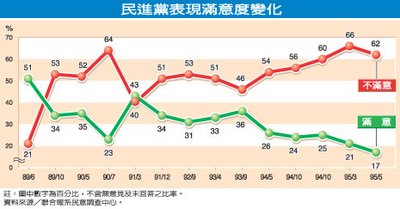 United Daily News Poll, May 18, 2006
The title at the top of the chart reads "Changes in Satisfaction Ratings for the DPP." The red line tracks increasing public dissatisfaction with DPP. The green line tracks decreasing public satisfaction with DPP. The dates along the bottom are Year of the Republic dates. The date on the far right "955" is the "95th Year of the Republic, May" i.e., May 2006.
Sad, isn't it, that the Pan Green camp has so thoroughly discredited itself, that its allegations can only be believed when they are confirmed by the Pan Blue majority opposition?
Notice that according to the Taiwan Solidarity Union poll, a mere 10% of the public favors the authoring of a new "Taiwanese Constitution" to replace the Chinese Constitution already in place?
You know the Deep Green TSU is being uncharacteristically honest when it announces a poll result so obviously unfavorable to its own Taiwan independence agenda.
So why did the TSU do it?
The TSU did it because although the TSU and the DPP are Pan Green camp allies, they are also Pan Green camp rivals. The TSU hopes to profit from the potential dissolution of the DPP as an organized political party. The TSU is behaving like a shark ready to feed on a wounded member of its own kind.
The TSU wants to persuade the public that if it was the leader of the Pan Green camp instead of the DPP, these numbers would be different. The TSU wants to persuade the public that if it was the leader of the Pan Green camp instead of the DPP, Taiwan independence would be a reality instead of a rapidly receding pipe dream.
That of course is nonsense. TSU godfather Lee Teng-hui had 12 long years during which he could have declared Taiwan independence at any time
But he never did.
Rectifying a Non-Error
Bevin Chu
May 17, 2006
US postal service rectifies Web site references to nation
Taipei Times
By Nadia Tsao
STAFF REPORTER IN WASHINGTON , WITH CNA
Wednesday, May 17, 2006
The United States Postal Service (USPS) has agreed to revise all references to the nation [sic] on its Web site from "a province of China" to "Taiwan" as requested by the Formosan Association for Public Affairs (FAPA), the Washington-based pro-Taiwan independence group said.
The postal service also issued an apology for having referred to Taiwan as a Chinese province, it added.
FAPA sent a letter to the postal service early last month at the request of its members. The letter stated that as an enterprise established by the US Congress, the postal service should abide by the rules and regulations of the US State Department, referring to a 1996 State Department memorandum that requests all relevant US government agencies and officials to refer to Taiwan as "Taiwan."
In a letter to FAPA dated May 9, the postal service stated that it regretted the error.
Comment: I know how one rectifies an error. But how does one rectify a non-error? I know that one should regret an error. But how does one regret a non-error?
Taiwan is a province of China. The Republic of China Constitution that is the basic law on the Chinese island of Taiwan says so clearly in black and white. So when Google and the USPS referred to Taiwan as "a province of China," they were absolutely correct. They had nothing to regret, nothing to rectify, and nothing to apologize for.
See: Google is still Right, Taiwan is still a Province of China
Ironically Google, which is under attack from the US federal government for allegedly caving in to pressure from Beijing, showed more respect for the truth than the USPS when Google refused to "rectify" its non-error, but instead bypassed the problem by removing all references completely.
Maybe the Hawaiian independence movement can now demand that the USPS stop referring to Hawaii as the 50th state of the union, and correctly refer to it as the Kingdom of Hawaii?
See: The Overthrow of the Monarchy
Now that would truly be rectifying an error. Now that would truly be something worth apologizing for.
Come to think of it, maybe now the US federal government can start treating all 50 states as sovereign and independent nations, as specified in the Articles of Confederation?
But don't hold your breath waiting for it to happen.
The Unprofessionalism of Professional Journalists
Bevin Chu May 16, 2006
In the past, the major media were the gatekeepers of public information. They wielded the power of veto over anyone who aspired to reach large numbers of the public.
With the advent of the Internet however, their defacto monopoly over the public forum has evaporated into thin air.
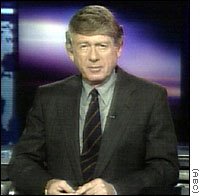
They know it, and they don't like it one bit. That's why "professional journalists" such as Ted Koppel have been so resentful of "amateurs with PCs."
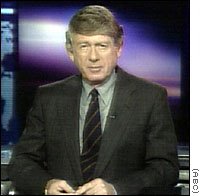 Ted Koppel Here's what Koppel said in 1997:Reporting is not really about, 'Let's see who can get the first information to the public as quickly as possible. It's about: 'Let's see who can get the information to the public - as soon as we have had a chance to make sure the information is accurate, to weigh it against what we know, to put it in some sort of context.' Only when you're satisfied as a professional journalist that you've got the story and the facts have been verified, only then can you go with it. If we are moving into an era in which reporters are pressured to get it online before we have a chance to check and edit the material - if speed is the main criteria of putting something online - then I think that's dangerous. Ultimately, a journalist has a responsibility to separate truth from rumor. There's always going to be room for the outlet that says, `We're not worried about geting it first, we're about getting it right.'What Koppel said was right in principle. What Koppel said was right in the abstract.
The problem is that Koppel isn't addressing the real issue. The problem isn't that "professional journalists" don't get it first. The problem is that "professional journalists" don't get it right, even when they get it last. The problem is that Koppel's "professional journalists" get it wrong, first, last, and always. For the past decade, for example, Koppel's so-called "professional journalists" have been getting the Taiwan independence issue dead wrong.
The Taiwan independence movement is not an idealistic and progressive political movement, but a bigoted and reactionary political movement. Only recently has this ugly truth become too obvious for the major media to hide. Only recently, therefore, have Koppel's "professional journalists" been getting the Taiwan independence issue right.Meanwhile, someone such as myself, who was not a "professional journalist," was getting the Taiwan independence issue right, for over a decade.
Anyone who doubts this claim need only read my online articles going back to the mid 90s. I hate to say "I told you so," but the fact is I did.
How did I do it? Was it some special genius on my part?
Hardly. All I did was look at the facts and listen to my conscience.
Why didn't Koppel's "professional journalists" get the Taiwan independence issue right?
They didn't get the Taiwan independence issue right because they turned a blind eye to the facts and a deaf ear to their consciences.
As political scientist Michael Parenti notes:The U.S. major media and much of the minor media are not free and independent, as they claim. They are not the watchdog of democracy but the lapdog of the national security state. They help reverse the roles of victims and victimizers, warmongers and peacekeepers, reactionaries and reformers. The first atrocity, the first war crime committed in any war of aggression by the aggressors is against the truth.Today, a decade later, the true face of the Taiwan independence movement has been exposed, not due to the major media, but in spite of the major media.How sad.As I see it, here is where honest amateurs have an indispensable role to play. Honest amateurs can expose the "professional journalists" for what they are, purveyors of the Big Lie. Koppel's talk about "professional journalists" who conscientiously engage in "fact-checking" is self-serving eyewash.
Phase Out US Commitment to "Defend Taiwan"
Bevin Chu
May 15, 2006
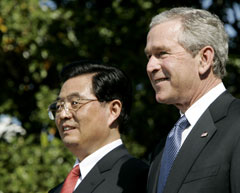 Hu Jintao and George W. Bush
The quasi-conservative, quasi-libertarian Cato Institute has reiterated a policy recommendation that every US legislator ought to take to heart. It has wisely recommended that the US phase out its long-standing commitment to "defend Taiwan."
I did not put the words "defend Taiwan" in scare quotes frivolously. I put them in scare quotes for a good reason. To refer to US policy as "defending Taiwan" rather than "aggressing against China" is Orwellian Newspeak.
A long time ago, in a galaxy far, far away, the US government's motive may have been to "defend Taiwan," rather than to use Taiwan as an expendable pawn in its effort to strategically "contain" China, but no longer.
If the US government's intentions were that benevolent once, they are benevolent no more. Today, right wing think tanks such as the Project for the New American Century (PNAC) don't even bother concealing their real motive for aiding and abetting the Taiwan independence movement, the Tibetan independence movement, Falun Gong, and "useful idiots" such as Wang Dan, Wei Jingshen, and Harry Wu.
Their real motive is to use these subversive elements within China as pretexts for economic, diplomatic, and if the opportunity presents itself, military intervention against China. Their real motive is to prevent China from ever becoming an economically prosperous, technologically advanced, First World nation comparable to the United States.
Some Americans, out of a misguided sense of what constitutes patriotism, may be tempted to endorse such strategies. That would be a mistake of the first order, both morally and practically.
Morally, such a malicious strategy of subversion is unworthy of America, a nation founded on the benevolent premise of peaceful trade for mutual benefit, not the malevolent "zero sum game" premise of social Darwinism.
Practically, such a strategy of containment might work against relatively small nations such as Serbia, Afghanistan, and Iraq, but they cannot possibly succeed against a nation the size of China.
If US political leaders maliciously attempt to keep a peacefully developing China down regardless, they will only squander America's national strength while transforming China into a resentful strategic rival when it could have and would have become a profitable trading partner.
Below is the Cato Institute article in question, with my editorial comments, both negative and positive.
May 15, 2006
The Bush Administration Snubs Taiwan
by Ted Galen Carpenter
Ted Galen Carpenter is vice president for defense and foreign policy studies at the Cato Institute.
This article appeared on Foxnews.com on May 12, 2006.
Cato: It was only a few years ago that Republicans castigated the Clinton administration for the way it treated Taiwanese leaders who had stop over visits to the United States during trips to countries that maintained diplomatic relations with the Republic of China (Taiwan’s official name).
Those criticisms were warranted. Clinton officials treated both current Taiwanese president Chen Shui-bian and his predecessor, Lee Teng-hui, as pariahs. During their stopovers, they were prevented from even meeting with members of Congress or the media–much less being allowed to give public speeches. Republicans accused the administration of kowtowing to China, which claims that Taiwan is merely a renegade province.
Comment: Those criticisms were not warranted. If a nation has recognized one political authority as the legitimate government of another nation, it ought to act in a manner consistent with that recognition. It ought not to deviously play one side against the other.
Cato: When it came into office, the Bush administration vowed to treat the leader of a sister democracy with far more consideration. And it did. The reception accorded Chen during his stopovers throughout Bush’s first term was cordial and respectful, despite strong objections from China. Chen routinely interacted with journalists, members of Congress, and public audiences while in the United States.
Comment: "Sister democracy" my foot. One expects democratic universalist tripe such as this from Frances Fukuyama, but the quasi-libertarian Cato Institute ought to know better. Shame on you. As George Washington admonished, "There can be no greater error than to expect or calculate upon real favors from nation to nation. It is an illusion, which experience must cure, which a just pride ought to discard."
Cato: Washington’s reaction was very different, however, regarding Chen’s latest trip in early May. This time, U.S. officials even refused his request to land in New York City for a refueling stop on his way to Central America. Indeed, they indicated that all airports in the United States would be off limits. They did offer to let him stop in Alaska, provided that he have no interaction with the public.
There appear to be two major reasons for Washington’s hostile response.
Throughout his presidency, Chen has pushed the envelope on Taiwanese independence, often infuriating Beijing and heightening tensions in the Taiwan Strait. He also has tended to blind side the United States with his initiatives–most notably with his decision in early 2006 to abolish the National Unification Council and the National Unification Guidelines. That action sent a blunt message to Beijing that Taiwan was not interested in political reunification with the mainland, now or in the future.
Chen’s behavior has produced rising annoyance in the State Department and even in the White House. U.S. officials have been looking for a way to administer a public rebuke to Chen, and it appears that they found one.
The other reason for snubbing Chen on his latest visit appears to be a calculation that the gesture would increase the likelihood that Beijing would be more supportive of U.S. calls for pressure on Iran in the ongoing nuclear crisis. If that was Washington’s expectation, it is extremely naive. China has an array of reasons for not wanting to antagonize Iran. A U.S. decision to snub Taiwan’s leader is far too limited a concession to sway Beijing’s decision.
Comment: Nonsense. This "explanation" parrots Taiwan Lobby media spin control. Taiwan independence Quislings hope to nudge the US back towards the illegal Chen regime by such indirect condemnation of Washington disguised as direct condemnation of Beijing. Ironically, such charges can only anger the Malevolent Global Hegemonists in the Bush administration, who consider themselves the Masters of the Universe. Any suggestion that Beijing has enough clout to coerce them into snubbing the Taiwan independence nomenklatura in Taipei is considered an affront to their manhood.
Cato: In any case, it is a shabby way for the United States to treat the leader of another democracy. Granted, it would have been improper for the administration to have formally recognized the visit or to have held meetings between executive branch officials and Chen. Washington maintains diplomatic relations with China, not Taiwan, and it does not dispute Beijing’s claim that China is part of Taiwan.
But Chen should have been accorded the respect and consideration given to any other distinguished foreign visitor.
Comment: The "leader of another democracy" who has been treated shabbily is Lien Chan, who won the 2004 ROC presidential election, but whom the Bush administration cheated out of office when it reneged on its promise to support the Pan Blue KMT/PFP alliance's demand for another election.
Cato: Washington’s conduct also smacked of crude interference in Taiwan’s internal political affairs. The treatment accorded Chen contrasted sharply with that accorded Taipei mayor Ma Ying-jeou, the leader of the opposition Kuomintang Party, during his trip to the United States a month earlier. Ma was allowed to make public speeches and was given very cordial receptions throughout his visit. Those contrasting actions convey a not-very-subtle message that Washington would like to see Ma as the next president of Taiwan.
Comment: Surprise, surprise, surprise. Doesn't Cato, which is supposed to be anti-interventionist, or at the very least, non-interventionist, realize that it is US insistence on having it both ways that leads to damned if you do, damned if you don't dilemmas like this? Cato needs to heed its own advice, cease its mealy-mouthed fence-straddling, and have the guts to commit itself fully to an anti-interventionist, or at the very least, non-interventionist foreign policy.
See: Scrap the Taiwan Relations Act
Cato: The current policy toward Taiwan is the worst possible combination. Washington maintains an implicit commitment to defend the island if China ever decides to use force to compel reunification. That is an increasingly dangerous and unwise commitment–especially as China’s economic and military power continues to mount. [emphasis added]
At the same time, U.S. leaders seem to believe that the defense commitment entitles Washington to meddle in Taiwan’s political affairs, seeking to affect the outcome of the island’s next presidential election in 2008.
A better course would be to phase-out the defense commitment [emphasis added] while showing proper respect for Taiwan’s elected leader. The latest incident suggests that Washington’s policy badly needs re-calibration.
Comment: Finally, Cato puts its finger on the crux of the matter: "A better course would be to phase out the defense commitment."
Phasing out any US commitments to "defend Taiwan" is not merely the "better course," it's the only course.
Never mind Cato's eyewash about "showing proper respect for Taiwan's elected leader." Chen Shui-bian is not "Taiwan's elected leader" in the first place. Lien Chan is the Republic of China's duly elected leader. Showing undeserved respect for unconstitutional usurper and US puppet Chen Shui-bian amounts to showing disrespect for Lien Chan, the Republic of China's actual leader, and the 53% majority of the electorate on Taiwan who voted for him.
See: Taiwan's Stolen Election
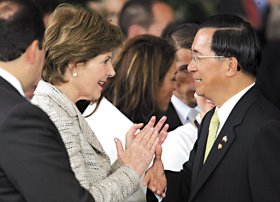
The Son of Taiwan accosts the First Lady of America
Bevin Chu
May 15, 2006
哥國大典 扁握蘿拉手要求合照At Costa Rican Ceremony A-Bian grabs Laura Bush's Hand demanding a Photo Op
2006.05.10 聯合報記者劉永祥United Daily News Reporter Liu Yong-hsiang
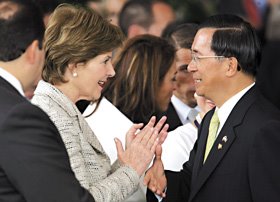 陳水扁總統八日在哥斯大黎加新任總統阿里亞斯的就職典禮中,主動伸手要與美國第一夫人蘿拉握手,但蘿拉正在鼓掌,陳總統一開始未能如願。美聯社 "President" Chen Shui-bian at Costa Rica President Arias's Inauguration Ceremony, pressures US First Lady Laura Bush to shake hands with him while she is still applauding. Associated Press
 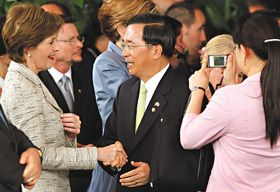 陳總統終於握到蘿拉的手,一旁待命的我國翻譯立即拿起相機抓住畫面。法新社 "President" Chen succeeds in pressuring Laura Bush to shake his hand, while his translator captures the moment. Agence France PresseComment: Chen Shui-bian, aka "A-Bian," apparently felt he hadn't offended the Bush administration enough by bailing out on US State Department personnel at the eleventh hour, after his request for transit through Alaska had already been approved.
Upon spying Laura Bush at Costa Rican President Arias' inauguration ceremony, Chen Shui-bian got it into his head to accost her, twice. Once at the beginning of the playing of the Costa Rican national anthem, and once again at the conclusion.
Video footage of the incident told the whole story, as the above still photos cannot. Anyone who knows anything about body language knows exactly what happened.
Diplomatic protocol prohibits a man from approaching a woman and pressuring her to shake one's hand. Any exchange between a man and a woman must be initiated by the woman, not the man. Laura Bush kept applauding, hoping "this person" would go away, sparing himself and her any embarrassment. When A-Bian refused to take the hint, she reluctantly shook his hand.
Not only did A-Bian shake Laura Bush's hand longer than was appropriate and longer than she was comfortable with, he trapped her right hand with his left hand in addition to his right, adding to her discomfort.
Not content with committing his diplomatic gaffe once, A-Bian rushed over to Laura Bush again as the Costa Rican national anthem concluded and repeated it a second time.
One can only imagine what George and Laura Bush said to each other later in the privacy of the White House about her encounter with this gauche buffoon.
This international faux pas, captured by the AP and AFP, was not merely a breach of etiquette, it was a highly revealing indicator of the deep ambivalence within the Taiwan "independence" Quisling mindset.
On the one hand Taiwan independence Quislings insist that they are proudly independent. On the other hand, they desperately crave affirmation and approval from certain significant others to whom they feel congenitally inferior, specifically former colonial master Japan and current imperial puppetmaster America.
As I wrote in "Diaoyutai and Pan Green Self-Delusion":
Nothing is wrong with Taiwanese (Chinese people on Taiwan) wanting to stand tall, walk out into the sunlight, and enjoy respect. This is a perfectly laudable, completely understandable, highly desirable goal.
During KMT Party Chairman Lien Chan's stunningly successful "Journey of Peace" to the Chinese mainland, CCP Party Secretary Hu Jintao explicitly acknowledged the legitimacy of Taiwanese wanting to "dang jia zuo zhu" (be masters in their own home).
Demands from Taiwanese for respect are not a problem. Within the framework of One China, as former PRC Premier Zhu Rongji once underscored, all kinds of concessions can be made, because any concessions would be made to one's fellow countrymen.
Demands for respect are a problem only when, as George Washington put it, "ambitious, corrupted, or deluded (i.e., Japanized) citizens, who devote themselves to the favorite nation (Japan)... betray or sacrifice the interests of their own country (China)."
Respect entails self-respect. Before others will respect you, you must first respect yourself. Self-respect in turn, entails self-affirmation. If one respects oneself, one will have no hesitation affirming who one is.
A reluctance to affirm who one is, a determination to pretend one is something one is not, is symptomatic of a deep-seated lack of self-respect. If one is reluctant to affirm who one is, if one is determined to pretend one is something one is not, one has already invalidated oneself at one's very core. Nothing one can do subsequently will ever make up for this initial act of self-invalidation.
The reluctance of Pan Green Quislings to affirm that they are Chinese, their stubborn insistence that they are "Taiwanese, not Chinese," their pathetic attempts to spin themselves as "quasi-Japanese," are all symptoms of the Pan Green Quislings' profound lack of self-respect. Pan Green Quislings who refuse to affirm who they are, who insist on pretending they are something they are not, have already invalidated themselves at their very core. Nothing they can do subsequently will ever make up for this initial act of self-invalidation.
The Laura Bush handshake fiasco was merely one more example of the humiliations Taiwan independence Quislings are doomed to inflict upon themselves as long as they refuse to confront the neurotic contradiction at the core of their "Taiwanese, not Chinese" identity politics.
See: Taiwan Independence and the Stockholm Syndrome
美國總統布希拒絕讓陳水扁總統過境美國本土,但陳水扁還是利用機會,兩度「主動的」握了布希夫人蘿拉的手。「美國總統夫人蘿拉布希。」大會司儀介紹美國第一夫人蘿拉,當她步上哥斯大黎加總統就職典禮會場舞台時,立即吸引了陳總統的注意。站在右邊第一排第四個位置的陳水扁,不時轉頭望向站在左邊第二排第二個位置的蘿拉。蘿拉進場後,數度與站在扁左側的墨西哥總統福克斯夫婦及薩爾瓦多總統薩卡談話,但沒有與扁互動;經過一段時間的等待,扁終於按捺不住,趁表演節目開始、大家各自談天的機會,大動作繞過他人,走到後排與蘿拉握手。兩人互動約一分鐘,扁習慣性地用左手拍拍她被緊握的手,還請隨行的西語翻譯向前。扁當場邀請蘿拉來台訪問,蘿拉則只是禮貌性地回答「謝謝」。典禮最後,哥國禮賓官向貴賓說明退場安排,福克斯率先離場,不過扁似乎另有期待,數度起身又坐下,注意蘿拉動態;同時與翻譯交談,交代事情。等待過程中,扁不時望向舞台前的攝影記者席,一度還握住手掌,用大拇指指向記者,隨後邁出步伐,再度走向蘿拉,開口問:「能不能跟妳合照?」扁再度出現,正在鼓掌的蘿拉似乎有些意外,沒有立即回應,當時蘿拉正在鼓掌,沒有注意到陳水扁已經伸出懸在半空中的右手,扁決定接住蘿拉還在胸前拍手的右手,蘿拉不知是驚嚇還是訝異扁找她合照,不自主的縮回左手,放在胸口上。扁則利用機會要蘿拉代向布希問好。扁的傳譯從隨身提袋裡拿出預先準備的相機,為兩人拍照,由於蘿拉沒有面向鏡頭,扁不但用手勢請她看向鏡頭,還拉著蘿拉的手請她稍微轉身,終於完成這場「走向蘿拉」的戲碼。為了替這場重頭戲宣傳,事後總統府還主動提供媒體由傳譯拍攝的兩人合照。2006/05/10 聯合報
The Taiwan Independence Quislings' Affront to Alaskan DignityT
Bevin Chu
May 14, 2006
The Taiwan News, like the Taipei Times, is a mouthpiece for the Taiwan independence movement.
To be fair, the Taiwan News is slightly less biased than the Taipei Times. The Taipei Times usually spikes any story unfavorable to the Taiwan independence movement, hoping it will never see the light of day.
The Taiwan News is marginally more willing to publish news unfavorable to the Taiwan independence movement, or in Ted Turner's priceless formulation, "news that we don't think the public ought to see."
Otherwise, these two Taiwan based Engish language newspapers are like Tweedledum and Tweedledee.
"Time to sock it to the U.S.", an editorial by Ryan Chieh, editor of the Taiwan News, offers us a revealing glimpse into the infantile, self-centered, narcissistic mindset of a typical member of the Taiwan independence nomenklatura.
Tuesday, May 9, 2006
Time to sock it to the U.S.
2006-05-09 / Taiwan News
Contributing Writer Ryan Chieh, editor, Taiwan News Weekly Magazine
Less than 12 hours before leaving on an eight-day trip to allies Paraguay and Costa Rica, President Chen Shui-bian decided to reject Washington's offer to refuel in Anchorage, Alaska. Taiwan tried unsuccessfully to arrange transit stops in higher profile U.S. cities and felt the offer of Anchorage was an affront to the country's dignity.
 US Postal Service Alaska Stamp
Comment: The US offer of transit through Anchorage, Alaska was indeed an affront. The US intended it as an affront, and the Chen regime took it as an affront, just as the US intended. But it was not "an affront to the country's dignity." It was an affront to Chen's "dignity." It was an affront to the ruling Democratic Progressive Party's "dignity." It was an affront to the Taiwan independence movement's "dignity."
I put the word dignity in scare quotes because Chen, the DPP, and the Taiwan independence movement have no dignity left to affront. Taiwan independence fellow travelers in the US may not have gotten the word yet, but in the hearts and minds of the Chinese people on Taiwan, the Chen regime, the DPP, and the Taiwan independence movement long ago forfeited any dignity they might once have had.
Don't believe me?
Then believe the lower echelon DPP officials who blasted Chen, upper echelon DPP officials, and hardline Taiwan independence "elders" for thoroughly discrediting both the DPP as political party and Taiwan independence as a political ideal during a recent DPP political strategy conference.
Believe the DPP's own confidential, in-house public opinion poll, later leaked to the press, which revealed an 18% approval rating for Chen and an 18% approval rating for the DPP.
Believe the political analysts of all political colors on Taiwan who suspect the 20 year young DPP may not survive past 2008.
But returning to my original point, why did the Chen regime, the DPP, and the Taiwan independence movement take the offer of transit through Alaska as an affront to their dignity?
Did the Pan Green camp take the offer of transit through Alaska as an affront solely because the US prohibited Chen from deplaning, from staying overnight, from holding press conferences and staging photo ops?
No. The Pan Green camp took the offer of transit through Alaska as an affront because Alaska was, as they loudly protested, not "mei guo ben tu," i.e., not part of the American mainland, not part of the continental United States, not part of America Proper.
Because Alaska was not contiguous with the "Lower Forty-eight," Chen, the DPP, and the Taiwan independence movement consider Alaska less than fully a part of America, and therefore the offer of transit through Alaska was "an affront to their dignity."
If you think I'm putting words in their mouths, read on.
Taiwan News: Taiwan's democratically elected president was not allowed to set foot on continental U.S. soil, [emphasis added] or to stay overnight in Anchorage or to address overseas Taiwanese groups ... Regardless of whatever reason the U.S. had for acting in this way, all of Taiwan's people should express their dissatisfaction and let the American government know that such treatment is unacceptable ... a president of a sovereign country who followed diplomatic courtesies in applying for a stopover, was stunningly restricted to a distant northern land [emphasis added] by U.S. officials ... The country's people should express their indignation to the American government in protest.
Comment: One of the Taiwan independence nomenklatura's loudest grievances is that in 1895, the mainland Chinese treated the Taiwan region of China as less than fully a part of China. A century later, the Taiwan independence nomenklatura cites this as one of its "justifications" for demanding Taiwan independence.
The reality, of course, was nothing of the sort. The reality was that a newly industrialized and vastly more powerful Japan held a gun to China's head and forced an agrarian China to make a heart-rending "Sophie's Choice." When the militarily overmatched Qing court was forced to cede Taiwan to Japan, an outraged Chinese people considered the loss of sovereign Chinese territory an intolerable injustice that had to be redressed, sooner if not later.
Fast forward one hundred years. When Chinese patriots on both sides of the Taiwan Strait insist that Taiwan must be reunified with the Chinese mainland, sooner if not later, they are restating their long held position that Taiwan is an integral part of China, and demonstrating unwavering consistency on the matter of China's territorial integrity.
Yet here we are in 2006, and what do we have but Taiwan independence Quislings meekly handing over Diaoyutai, a Taiwanese island of inestimable value, to Japan without even a whimper, let alone a fight. And they have the audacity to fault the Qing court for not putting up enough of a fight against Japan in order to hold on to Taiwan? At least the Qing court put up a fight.
Yet here we are in 2006, and what do we have but Taiwan independence Quislings, many of whom are US citizens, living on "mei guo ben tu," the American mainland, the continental United States, America Proper, holding the very view of Alaska that they accuse Chinese of holding about Taiwan in 1895.
The Alaskan Independence Party considers Alaska to be "a distant northern land" not part of "continental US soil." The Alaskan Independence Party however means this in a positive sense. The Alaskan Independence Party considers the Sovereign State of Alaska to be an independent nation, as specified in the Articles of Confederation.
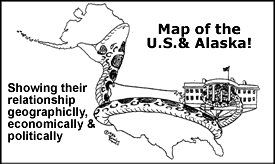 Alaskan Independence Party's View of Alaska's Relationship to the US
Taiwan independence Quislings also consider Alaska to be "a distant northern land" not part of "continental US soil." Taiwan independence Quislings however, mean this in a negative sense. Taiwan independence Quislings consider Alaska to be of lesser status than the "Lower Forty-eight" because, as they loudly protested, Alaska is not "mei guo ben tu," not part of the American mainland, not part of the continental United States, not part of America Proper.
Alaskan Independence Party's View of Alaska's Relationship to the US
Taiwan independence Quislings also consider Alaska to be "a distant northern land" not part of "continental US soil." Taiwan independence Quislings however, mean this in a negative sense. Taiwan independence Quislings consider Alaska to be of lesser status than the "Lower Forty-eight" because, as they loudly protested, Alaska is not "mei guo ben tu," not part of the American mainland, not part of the continental United States, not part of America Proper.
 Alaskan Independence Party Bumper Sticker
The State of Alaska's proud inhabitants, both those who advocate independence, and those who advocate remaining in the Union, should "express their indignation to the DPP government in protest.
Alaskan Independence Party Bumper Sticker
The State of Alaska's proud inhabitants, both those who advocate independence, and those who advocate remaining in the Union, should "express their indignation to the DPP government in protest. "
Time to sock it to the Taiwan independence nomenklatura.
World is Stuck with "Him"
Bevin Chu
May 10, 2006
China Post EditorialWednesday, May 10, 2006World is stuck with 'him'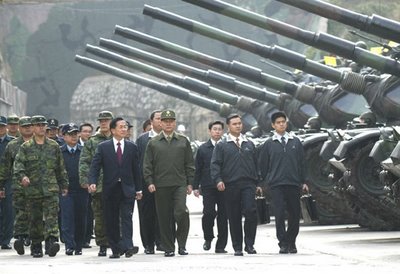
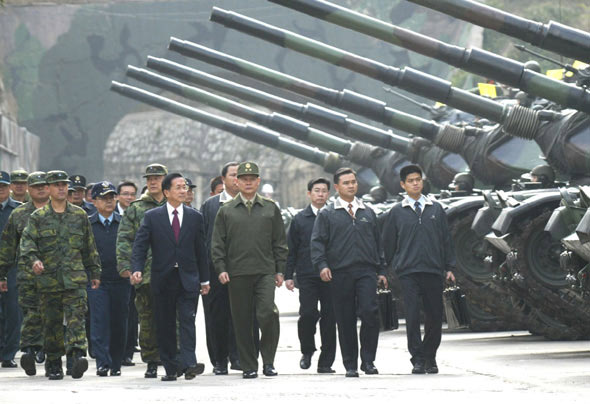
Chen Shui-bian, "Commander in Chief "
China Post: The China Post has received many letters to the editor, urging President Chen Shui-bian to resign as soon as possible for the good of his family, his party and his country because his poor performance has done enough damage to them all already. Two more years of suffering are simply too much. Chen's traditional supporters are also deserting him; his approval rating has sunk to the lower teens. But to the dismay of everybody, an early departure of Chen is unlikely. According to the Constitution, the president can be impeached or recalled, but the thresholds are too high to even be contemplated.Comment: The China Post notes that "According to the Constitution, the president can be impeached or recalled, but the thresholds are too high to even be contemplated." The China Post is correct.
The constitution the China Post is referring to however, is not the Republic of China Constitution according to Original Intent and Strict Construction. The constitution the China Post is referring to is Lee Teng-hui's "amended" constitution, a legal counterpart to Viktor Frankenstein's reanimated monster. Lee created this affront to constitutionalism and the rule of law during his imperial presidency, for two purposes.
First, to ensure that Lee himself could do whatever he damn well pleased and never fear impeachment or recall.
Second, to transform the Republic of China Constitution into an abomination that inspires only disgust, providing a convenient pretext for the eventual authoring of of a "Republic of Taiwan Constitution" to take its place.China Post: To impeach the president, the motion must be initiated by at least half, and endorsed by two-thirds of the total members of the Legislature and then, presented to the 15-member Council of Grand Justices for adjudication.To recall the president, it requires initiation by one-fourth and endorsement by two-thirds of the total members of the Legislature and finally, approval by 50 percent of the valid ballots cast by at least 50 percent of eligible voters in a national referendum.Comment: Why? Why such ridiculously high thresholds for the impeachment and recall of a president? One need not be Chief Justice of the Supreme Court John Marshall to realize that legal thresholds as absurdly high as these make whoever is elected president utterly unimpeachable and unrecallable.During Lee Teng-hui's reign the Taiwan independence nomenklatura blocked an eminently sensible New Party amendment requiring run-off elections and an absolute majority to elect a president, but rammed through a string of amendments that included this outrageous supermajority threshold for the impeachment or recall of a president.Democratic universalists assure the world that "Democracies, in contrast to other political systems, respect the will of the people." Really? Then why did "Mr. Democracy" Lee Teng-hui make it harder for the people to rid themselves of him than to elect him?
Shouldn't it be as easy, if not easier for the people to rid themselves of an elected official, than to put him or her in office in the first place? Chen Shui-bian was elected president by a 39% plurality in 2000 through a direct vote. If a 39% plurality was considered enough to install him in office, why isn't a simple majority, also through a direct vote, enough to "uninstall" him from the same office? Wouldn't that be more "democratic?" Wouldn't that be real "democracy?" Why would "champions of democracy" oppose such an arrangement? Why have "champions of democracy" opposed such an arrangement? What possible explanation can there be for such a baffling and illogical arrangement, except that aspiring dictators want to make it as easy as possible for themselves to get into office, but as difficult as possible for betrayed and disillusioned voters to remove them from office once they are in?Why would any sitting president "amend," i.e., pervert, sabotage, undermine, the constitution of the nation he is presiding over in such a manner?Why else, except to transform a perfectly good constitutional republic into a democracy and oneself into democracy's worst by-product, an elective dictator? Why else, except to transform the Republic of China, a perfectly good constitutional republic, into a "Democratic Republic of Taiwan?"Has anyone forgotten this was the handiwork of the Taiwan independence Quisling whom Newsweek magazine anointed "Mr. Democracy?"China Post: That leaves the last resort -- demonstrating people power to force the president to resign, as happened in the Philippines and Thailand. Taiwan's people are ready to do that, but they dread to see Chen's deputy as their next leader.Comment: This, needless to say, is precisely what "champions of democracy," i.e., aspiring elective dictators, count on. They know perfectly well that People Power takes an eternity to kick in and take effect. People have jobs to go to and lives to live. They don't have either the time or energy to take to the streets in protest every time elected officials engage in power grabs.
When they do eventually take to the streets, it is invariably as a last, desperate resort. It is invariably because by then they are "mad as hell, and not going to take it any more!"
Long before that however, democratically chosen elective dictators will have already gotten everything they wanted from democracy, the worst political system ever tried.
People who still believe in democracy at this late date need to disabuse themselves of the fairy tale notion that "Democracy is a political system of the people, by the people, and for the people." Democracy is no such thing. Democracy is a political system of an elective dictatorship, by an elective dictatorship, and for an elective dictatorship.
It is time for intellectuals, at least those worthy of the name, to give serious thought to adopting a radically new political system to replace democracy. It is time for cutting edge intellectuals to consider the adoption of market anarchism, the best political system ever tried.
Until then, intellectuals in politically mature nations of the world should insist on the second best political system every tried, a constitutional republic.
Journey to Nowhere, the Return Trip
Bevin Chu
May 08, 2006
FT.comTaiwan leader responds to US snub with global odysseyBy Kathrin Hille in TaipeiPublished: May 9 2006 01:32 | Last updated: May 9 2006 01:32FT: Taiwan’s international isolation became all the more evident last week when the island’s president, on his way to Paraguay, scrapped a planned stop in Alaska. Mr Chen Shui-bian opted instead for a stopover – later aborted – in Beirut, a detour via Abu Dhabi and refuelling in Amsterdam. Analysts said Mr Chen’s odyssey also highlighted the risk that the president could become unpredictable during his last two years in office. They said he might be increasingly willing to risk the ire of the US – Taiwan’s sole protector against threats from [mainland] China and its single most important unofficial ally – if it helped his political agenda. Mr Chen’s detours were organised after Washington offered no more than refuelling in Anchorage or Hawaii for his trip, a substantial downgrade compared with previous US transits when he was allowed to spend a few days in the country, hold meetings and give speeches. Expressing his anger over what he considered to be a clear snub, Mr Chen reciprocated with his strange, intercontinental tour. “The more we get frustrated, the braver we have to be,” he said on Taiwanese television.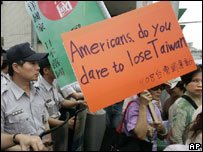
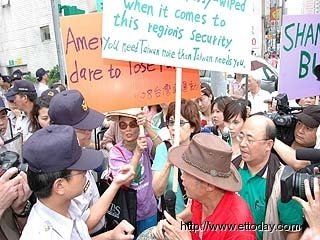
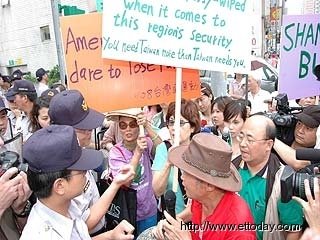 Taiwan independence True Believers raging against the US
Comment: Taiwan independence Quislings are now blasting the Bush administration over its deliberately humiliating offer of transit through Alaska. I hesitate to say so, but I couldn't have manifested a more positive development if a Jinni had emerged from a lamp and granted me three wishes.The reason I hesitate to say so, is that I have never forgotten Napoleon's famous advice, "Never interrupt your enemy when he's making a mistake."Taiwan independence Quislings are making the biggest mistake of their life. Their only chance of carving a chunk out of China's sovereign territory and relabeling it the "Republic of Taiwan," is to remain servile and obedient puppets of Washington's Malevolent Global Hegemonists, no matter how badly they are treated in the process. Actually, it is an increasingly remote chance, but it is their only chance. Without the direct military intervention of the their puppetmasters in Washington, Taiwan "independence," if you can call it that, has a "Chinaman's chance" of success.
When Chen thumped his chest and insisted that “The more we get frustrated, the braver we have to be,” what he said in Chinese was "yue cuo, yue yong," which literally translated means, "the greater the frustration, the greater the courage." But since the word for "frustration" in Chinese is a homonym of the word for "error," Pan Blue pundits wasted no time mocking Chen's bravado as "the more serious the error, the greater the foolhardiness."
As their pathetically naive protest signs reveal, Taiwan independence True Believers don't understand their designated role in the Malevolent Global Hegemonists' New Cold War against China. They don't realize they are nothing more than Uncle Sammy's sacrificial pawns. They actually believe "You need Taiwan more than Taiwan needs you." The only reason I have gone ahead and pointed out the Taiwan independence Quislings' catastrophic mistake, is that the Taiwan independence nomenklatura is not about to correct its mistake based on what some Deep Blue pundit says on the Internet, no matter how widely his weblog is read.FT: Ties with Washington have been less than smooth since Mr Chen angered Beijing by proposing constitutional reforms and holding a referendum on cross-Strait issues in 2004. “The big question now is whether he is spinning out of control,” said a US expert on Taiwan affairs. Mr Chen is struggling in his final term, which ends in May 2008. His approval ratings have plummeted, while the opposition’s legislative majority means that most of his policies have been blocked, raising the possibility that he may leave office without having achieved anything. Some analysts said this makes populist appeals to Taiwanese nationalism, even if they result in rising tensions with China and a rift with the US, one of the few choices Mr Chen has left.Comment: As Hermann Goering, (1893-1946) the founder of Nazi Germany's secret police, the Gestapo put it, "Naturally the common people don't want war; neither in Russia, nor in England, nor in America, nor in Germany. That is understood. But after all, it is the leaders of the country who determine policy, and it is always a simple matter to drag the people along, whether it is a democracy, or a fascist dictatorship, or a parliament, or a communist dictatorship. Voice or no voice, the people can always be brought to the bidding of the leaders. That is easy. All you have to do is to tell them they are being attacked, and denounce the pacifists for lack of patriotism and exposing the country to danger. It works the same in any country."
Lee Teng-hui and especially Chen Shui-bian have been dragging the people along, bringing them to do their bidding, telling them they are being attacked, and denouncing the pacifists for lack of patriotism and exposing the island to danger. As Goering shrewdly noted, it is a simple matter and works the same in any country.
Charles W. Freeman, Jr., former U.S. Ambassador to Saudi Arabia, warned about this alarming development in a speech he delivered on June 25, 2004: It is in our interest to convince Taipei that it is both playing with fire and becoming dangerously distant from its sole protector, the United States. It is not in our interest for Beijing to accomplish this for us by upping the military threat to Taiwan or taking a bite out of the island. The Bush Administration, as recently as yesterday, has spoken out ever more bluntly in an effort to instill realism into Taipei and to deter it from taking steps that will provoke such unilateral action by Beijing. Mr. Chen has not only brushed these warnings aside, he has ensured that his partisan press ignores and distorts the Administration's message so that it is never heard or read by his followers. It is becoming clear that words alone may not be enough to convince the Taiwan authorities not to jeopardize the island's future and our own; punitive actions may be required.
The Bush administration's denial of transit through the lower 48 is just such a belated and frankly long overdue "punitive action."
FT: US officials indicated that the Anchorage offer that infuriated Taipei so much reflected a lack of confidence in Mr Chen. Analysts said that when he had been given more favourable treatment, he had made his stopovers a “political show” for domestic consumption, and Washington did not trust Taipei to steer clear of similar action this time. “Mr Chen has managed to widely erode support in the most pro-Taiwan administration in recent memory,” said the US expert. When Mr Chen earlier this year broke a promise not to scrap an advisory body responsible for working towards unification with China, US delegates were assured by his aides in private that his other commitments – such as refraining from declaring independence – were still valid. However, Washington subsequently found it impossible to get a personal confirmation of this from him. “He says one thing and does another,” said the US expert. “He behaves like a lawyer”Comment: For once, an alleged "US expert" on Taiwan affairs actually lives up to the appellation. Whoever this unnamed US expert is, he actually understands Chen Shui-bian's exasperatingly stubborn and appallingly selfish psychology, as few so-called experts on China do.
When this unnamed US expert says that Chen "says one thing and does another" and that "he behaves like a lawyer," he isn't merely telling another lawyer joke, he's revealing that he has Chen Shui-bian profiled every bit as accurately as Pan Blue political analysts on Taiwan, who have long accused Chen and other Pan Green lawyers turned politicians of displaying a classic "luu shi xing ge" (lawyer's personality).
This US expert correctly notes that “Mr Chen has managed to widely erode support in the most pro-Taiwan administration in recent memory.”
How did this come about?
Ironically, this came about precisely because the Bush administration was "the most pro Taiwan [independence] administration in recent memory." This came about because the Bush administration handed the Chen administration a blank check by vowing to "do whatever it took [sic] to defend Taiwan."
Bush wrote the check. Chen merely cashed it.
See: The Taiwan Tail wags the American Dog
FT: Randall Schriver, former deputy assistant secretary of state, said US-Taiwan relations would now enter a “cooling-off period”, and Taipei needed to engage in close communication with Washington to stop an emerging “negative cycle” in bilateral ties.Comment: From the Taiwan independence Quislings' perspective, Schriver is right on the money. Assuming the Taiwan independence nomenklatura is still serious about realizing its treasonous ambition of Balkanizing the Chinese nation, it ought to first cool off, then kiss up to its puppetmasters in Washington. But I'm guessing, as well as hoping, it won't happen. The individuals who comprise the Taiwan independence nomenklatura are far too myopic, and more importantly, far too selfish to step forward and stop the emerging downward spiral in puppet to puppetmaster ties. They have had six years to engage in self-retrospection as the Pan Blue opposition pointed out their mistakes. Is two more years really going to make any difference?
FT: Mr Chen’s chosen route for his return journey from Paraguay will be the first test whether Taipei is ready to do so. As of yesterday, the government had not made it clear whether the president would stick to plans for a transit through Anchorage tomorrow.Comment: The latest word as of the afternoon of Tuesday May 9, is that Chen has decided not to kiss and make up with the Bush administration. He intends to continue thumbing his nose at the Bush administration and to return in the same direction he came. Needless to say, this pundit welcomes his decision. I look forward eagerly to hearing State Department Spokesman Sean McCormack refer to Chen Shui-bian as "it."
Chen Shui-bian recently compared the relationship between his Pan Green Quisling regime in Taipei and Bush's Malevolent Global Hegemonist regime in Washington with the relationship between the two main characters in Ang Lee's film Brokeback Mountain.
Chen's clueless analogy may turn out to be more ironically appropriate than even he imagined. Brokeback Mountain depicted a hopeless and doomed relationship that ended in tragedy when one of the two parties died a violent and unnatural death. Between the Pan Green Quislings in Taipei and the Malevolent Global Hegemonists in Washington, whom do you imagine is going to die a violent and unnatural death? I know whom I'm betting on. How about you?
Kremlinology
"Kremlinology," according to Wikipedia, is the study of Soviet politics and policies based on the inner workings of the Kremlin, the seat of the Soviet government. During the Cold War, lack of reliable information about the country forced Western analysts to "read between the lines" and to use the tiniest tidbits, such as the removal of portraits, the rearranging of chairs, the assignment of positions on the reviewing stand for May Day parades, and other indirect signs to understand what was happening in internal Soviet politics.
Now that the Soviet Union has been relegated to the dustbin of history, today's "Kremlinology" is the study of the politics and policies of the new "Evil Empire," based on the inner workings of the White House, the seat of Imperium Americanus. Now that Washington has unilaterally declared a "New Cold War" against China, latter day Kremlinologists "read between the lines" and rely on indirect signs to understand what is happening in internal Beltway politics.
The State Department's Daily Press Briefings, for example, have been providing unmistakable signs of the Bush administration's increasing frustration with and contempt for its unruly puppet regime on Taiwan.
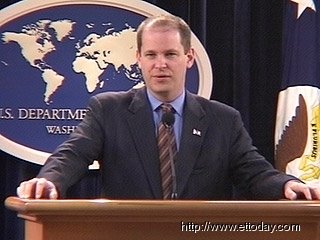
State Department Spokesman Sean McCormack's Daily Press Briefing on May 4, 2006, was especially revealing:
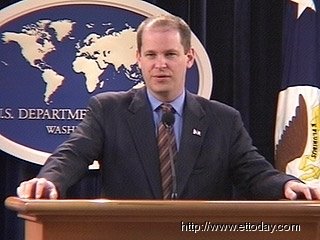 State Department Spokesman Sean McCormack
Daily Press Briefing
Sean McCormack, Spokesman
Washington, DC
May 4, 2006
QUESTION: Thank you, Sean. Do you have any updates on Taiwan's President Chen's transit through the United States?
MR. MCCORMACK: Well, I understand he will, on his outbound leg to his destination in South America, or destinations in South America, that he will not be transiting the United States. It is an open question whether or not -- whether on the way back he will transit the United States. As of this point, we don't have a request for that, but if we do receive the request we will certainly look at it consistent with our past practice on that question.
QUESTION: A follow-up. In the past, the U.S. has approved Taiwanese leaders to transit through other U.S. cities like New York, San Francisco, which were more preferable to the Taiwan side. Can you tell us why this time the U.S. put only stops in Alaska?
MR. MCCORMACK: There was an offer of transit through Anchorage, Alaska, which we thought was appropriate. We take each of these requests on a case-by-case basis. Each of them we take on their individual merits and beyond that I don't have any further comment on it.
QUESTION: One last follow up, sir. In your (inaudible) yesterday, you called Chen Shui-bian "he" and never once did you address his title and you are the spokesperson and a diplomat, I would assume your expressions are --
MR. MCCORMACK: "He" referred to Chen Shui-bian.
Yes.
QUESTION: Excuse me, can I follow up on this President's transit issue? By rejecting the U.S. offer to transit in through Alaska, President Chen is obviously, you know, showing his displeasure with the U.S. arrangement. Do you think there will, you know, a chilling effect of current and future U.S.-Taiwan relations?
MR. MCCORMACK: First of all, I would refer you to his -- Chen Shui-bian's traveling party for a comment on why they chose not to transit through Alaska. And as for the second part of your question, I would expect that it would not have any effect.
Yes, Nicholas.
QUESTION: The transit -- was that meant to be just to refuel for a couple of hours or was that supposed to include an overnight if the timing coincided or --
MR. MCCORMACK: Again, you can talk to his traveling party about that.
QUESTION: Well, no, but wait a second. This is a serious decision -- was that -- what does transit mean? Does it mean 24 hours, less than 24 hours, 12 hours? What does it mean?
MR. MCCORMACK: It has meant different things at different times.
QUESTION: Okay.
From "President Chen" to "He"
State Department spokesmen initially referred to Chen as "President Chen Shui-bian."
After Chen reneged on his Five Noes Pledge and began making trouble for Washington, State Department spokesmen began referring to Chen as "Mr. Chen," dropping the title "President."
After Chen ignored the exhortations of US envoys discreetly dispatched to Taipei by the Bush White House, State Department spokesmen began referring to Chen as "Chen Shui-bian," dropping even the "Mr." ordinarily granted to any Tom, Dick, or Harry.
After Chen openly thumbed his nose at the US by changing his flight plans at the eleventh hour, after agreeing to and applying for transit through Anchorage, Alaska, State Department spokesmen began referring to Chen as "he," refusing even to say his name.
None of this escaped the notice of reporters present at the State Department Daily Press Briefing, who asked McCormack to clarify the government's position.
Nor has any of this escaped the notice of Kremlinologists on Taiwan, several of whom joked that at least State Department spokesmen didn't refer to Chen as "it." Not yet anyway.
But stay tuned. Who knows what State Department spokesmen will call Chen next? After all, we haven't forgotten that behind closed doors Bush Jr. refers to Chen as "That SOB," have we?
The Taiwan Independence Movement's Journey to Nowhere
Bevin Chu
May 05, 2006
By now everyone who follows cross-Straits and Sino-US relations has read about how "president" Chen Shui-bian's state visit to Paraguay and Costa Rica degenerated into a real life version of National Lampoon's Vacation (1983, directed by Harold Ramis, written by John Hughes, starring Chevy Chase).

National Lampoon's Vacation
A May 6, 2006 China Daily article entitled "Taiwan leader's 'transit diplomacy' snubbed" summed up the fiasco:
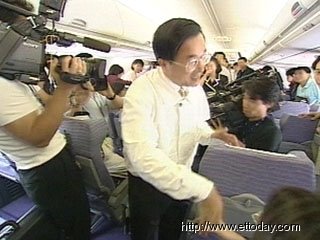
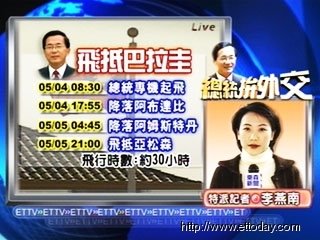
Taiwan leader Chen Shui-bian's new attempt to promote "transit diplomacy" has suffered as his trip to Latin America turned out to be what the island's media dubbed "a journey to nowhere" (mi hang zhi luu). The start of Chen's eight-day visit to Paraguay and Costa Rica, two of just 25 countries that recognize Taipei, was marred by his plane changing its flight plan in mid-air and making an unscheduled landing in the United Arab Emirates and the Netherlands. Taiwan's TVBS television reported on Friday that Chen's plane left Taipei early Thursday morning with the intention of landing in Beirut, Lebanon, on its way to Asuncion, Paraguay. But it landed in Abu Dhabi instead after Lebanese authorities denied it permission to land. The plane was then forced to land in Amsterdam on Friday for a second refuelling stop although it had planned to head to the Dominican Republic, another country that recognizes Taipei. The TVBS report said that the plane was unable to take on enough fuel in Abu Dhabi to allow for a flight to the Dominican Republic due to technical reasons, forcing the plane to land in Amsterdam. The unusual moves came after Chen unexpectedly dropped plans to stop in the United States only hours before starting his visit on Thursday.
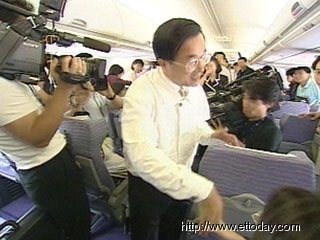
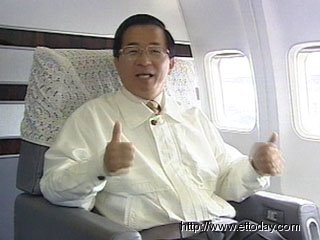 "President" Chen Shui-bian
Comment: As the setbacks began to pile up, like cars in a freeway chain collision, an increasingly petulant Chen Shui-bian ordered a total news blackout. Reporters assigned the thankless task of covering Chen's "journey to nowhere" were denied the right to communicate with the outside world, and even kept in the dark about their next transit stop. They had to guess where they would land next by checking pocket compasses and world maps. Their ordeal lasted for 37 hours. Thirty hours in the air, plus seven hours on the ground. The reporters said they felt like victims of a hijacking. The justification given for such treatment? You guessed it, "For reasons of national security." Yet another example of Chen's much touted "100% press freedom."
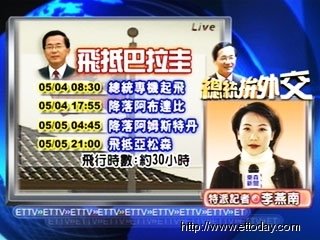
Arrival Times for Chen's "Journey to Nowhere"
On second thought, Chen's "journey to nowhere" might better be compared to ABC's hit TV series Lost (2004, created by Damon Lindelof, Jeffrey Lieber, J.J. Abrams). Can anyone think of a more succinct description of the Taiwan independence movement's current plight than "Lost?"
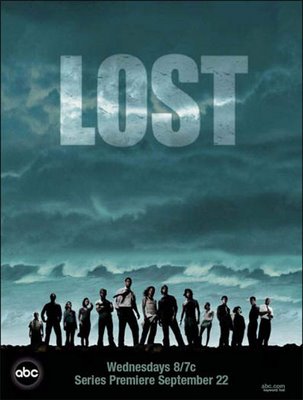 TV Series Lost Most western news accounts however, fail to explain why Chen's trip went so terribly wrong. Many parrot the DPP's predictable accusation that Beijing "blackmailed" Washington into humiliating Chen Shui-bian.
The DPP knows that its kneejerk accusation is nonsense. Beijing only wishes it was that powerful. After all, the Bush administration just got through insulting Hu Jintao during his recent US visit by deliberately referring to the "People's Republic of China" government as the "Republic of China" government, and by deliberately allowing a known Falungong agent provocateur to obtain a press pass and heckle Hu Jintao for three minutes before leading her away.
These incidents were no accidents, any more than the May 7, 1999 US bombing of the Chinese Embassy in Belgrade was an accident. These incidents were, as the vernacular expression puts it, "accidentally on purpose."
The Bush administration deliberately staged these incidents to reassert, in the face of all the strategic analysts' irksome predictions of a future 21st Century Chinese superpower, that the US hegemon was still the current 21st Century superpower, and Hu Jintao had better not forget it.
The Bush administration deliberately shunted Chen off to Alaska to remind Chen that for all the democratic universalist/democratic pacifist eyewash about "mutual respect between democratic allies," Uncle Sam is the puppetmaster, the Pan Green Quisling regime on Taiwan is the puppet, and Chen Shui-bian had better not forget it.
Pan Green Quislings in Taipei would make trouble for Beijing only when Benevolent Global Hegemonists in Washington determined it would advance US hegemony, not when Pan Green Quislings determined it would advance Taiwan independence.
See: A Slap heard across the Pacific
Chen reacted to the humiliating offer of transit through Anchorage, Alaska, by throwing an infantile temper tantrum and ordering a last minute alteration to his flight plan. This impromptu change in his flight plan was what led to the now infamous comedy of errors.
China scholar Alan Romberg, as the following news report reveals, is among the few observers who actually got the story right.
Expert says 'breach of faith' spurred U.S. decision
Taiwan News
2006/05/05 13:51:16
A breach of faith by Taiwan could have been responsible for Washington's decision to limit President Chen Shui-bian's planned transit stops in the United States during his latest Latin American visit, an American expert in cross-Taiwan Strait issues said Wednesday.
Alan Romberg, director of East Asian studies at the Henry L. Stimson Center, said he does not think the decision was taken to satisfy Chinese President Hu Jintao or in response to Beijing's threats, as pan-green commentators in Taiwan have suggested. Instead, the limitations "seem clearly related to deep American concern over statements he (Chen) has made and actions he has taken since the beginning of this year," Romberg said.
"While Chen would like the U.S. to see his various steps as appropriate in the course of building democracy, when viewed from an American perspective, they appear as a breach of faith and a violation of various pledges," Romberg observed.
These include the differences between Taipei and Washington over maintaining Chen's "five noes" pledges and the handling of the National Unification Council and National Unification Guidelines, according to Romberg.
Also related is Chen's advocacy of a constitutional revision process that runs counter to earlier pledges, Romberg said.
While Chen said in his inaugural address that sensitive issues regarding national territory and sovereignty and the subject of unification and independence would be excluded from his proposed constitutional re-engineering effort, the president now says that he "does not have the right" to prohibit the expression of people's opinions, Romberg pointed out.
Evergreen No More
Bevin Chu
May 05, 2006
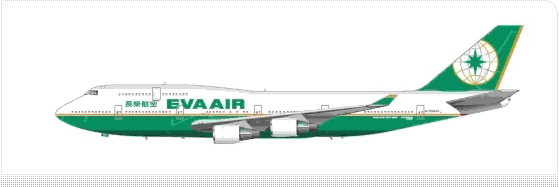
Chen Shui-bian's Journey to Enhance Popularity / Detour Diplomacy is a May 5, 2005 news report from ETToday News, a major cable TV news station on Taiwan. This is the kind of news story that English speaking readers are unlikely to ever read on the pages of the Taiwan independence mouthpiece known as the Taipei Times, because it is simply too devastating. Chang Rong-fa, in case you are unfamiliar with the name, is the Chinese shipping magnate who heads up the Evergreen Group, the parent company of Evergreen Marine Corporation, the fourth largest maritime shipping in the world, as well as EVA Air, one of the largest customers of Boeing planes in the world. If you have ever been to a port, you have probably seen Evergreen shipping containers being moved about by cranes. If you have ever been to an airport, you have probably seen EVA Air passenger planes taxiing along the runway. Evergreen Marine Container Ship
  EVA Air 747-400
Chang Rong-fa, along with Chi-mei Enterprises' now retired CEO Hsu Wen-long, used to be one of the Taiwan independence movement's most generous benefactors. Chang's relationship with Chen Shui-bian goes back 30 years, to when Chen was just beginning his political career. When Chen was a mere freshman in the ROC legislature, he had a staff of two dozen people, provided him free of charge by Chang Rong-fa.
Chen would not be where he is today without Chang. As far as Chen Shui-bian is concerned, he owes his presidency to Chang Rong-fa. As far as Chen is concerned, Chang is a king-maker, and Chen is the king Chang made. Keep this in mind as you read the following news report.
Chang Rong-fa used to be so "green," i.e., pro DPP, pro Taiwan independence, that not only were his ships and planes painted bright green, even his corporate headquarters buildings were clad in bright green ceramic tiles.
DPP Party Flag
The defection of immensely powerful and influential Pan Green business figures such as Chang Rong-fa and Hsu Wen-long from the ranks of the Taiwan independence movement effectively marks the demise of Taiwan independence as a political force.ETToday NewsChen Shui-bian's Journey to Enhance Popularity / Detour Diplomacy, Chang Rong-fa criticizes Chen Shui-bian's diplomatic visits, asking what's the point?2006/05/05 11:59Center for Economics and Finance / Combined ReportEnglish Translation by Bevin Chu:The president's visits [to Paraguay and Costa Rica] have encountered a string of setbacks, even as Evergreen Group president Chang Rong-fa, who is about to build a new Evergreen Group headquarters building in Shanghai, prepares to visit the mainland next week to meet with mainland president Hu Jintao. During a visit to Tokyo Chang criticized the Chen government, saying that even before Chen left Taiwan, the governments he was preparing to visit began demanding money. "What's the point of this kind of diplomacy?" Chang said "The Chen administration has been in office six years, and still the only thing they can think about is gaining a political advantage and electioneering."When interviewed on February 5, 2004, Evergreen Group president Chang Rong-fa said that the president was a fool. "I tried to explain maritime transport to him but he couldn't understand."Two years ago Chang pubicly criticized the president over the issue of direct postal, maritime shipping, and commercial air passenger links [between the Taiwan and mainland regions of China]. This time, Chang, who is currently in Tokyo, couldn't resist criticizing him again. Chang said the ruling party had been in office for six years, yet all it could think about was gaining political advantage and electioneering. This presidential visit hadn't even gotten off the ground before the governments he was preparing to visit began demanding money. "What's the point of this kind of diplomacy?" Chang said, if it were up to him, he wouldn't go.Chang Rong-fa said that over the past few years far too many economic opportunities had been blocked by the government. Large scale enterprises can survive by doing business in other countries, but what are ordinary folks earning a meager income operating small businesses supposed to do? Chang said the president and ruling party shouldn't do nothing but denounce others all the time. Considering how Hong Kong was becoming more prosperous day by day following its retrocession to China, Chang asked, what evidence could the Taiwan authorities cite to prove that our current arrangement is superior to One Country, Two Systems?Chang Rong-fa, who has met with Jiang Zemin and Zhao Ziyang a number of times, will fly to Beijing next week to meet with Hu Jintao. .Chang said that the mainland was rapidly moving in the direction of democratic socialism, while Taiwan paradoxically was moving in the direction of a "locked nation policy" and turning away economic opportunities. He said bluntly that this was an extremely unfavorable development. Chang went so far as to propose a future One Country, Two Systems confederation as an option for the two sides of the Taiwan Strait, and said that whoever is in power should give more thought to how to improve the people's livelihood.Only last month Chang Rong-fa's son Chang Kuo-cheng shook hands with Hu Jintao for a full eight seconds at the KMT/CCP forum. Today, while in Tokyo, Chang Rong-fa harshly criticized the ruling DPP's cross-Straits policies to the media, revealing the extent to which Evergreen is aggressively shedding its "Pan Green Enterprise" political label and establishing its foothold on the Chinese mainland.Original Chinese:東森新聞報興揚之旅/繞道拚外交 張榮發批扁出訪有何意義?2006/05/05 11:59財經中心/綜合報導總統出訪一波三折,即將在上海興建長榮總部的長榮集團總裁張榮發,就在下周要去大陸和大陸主席胡錦濤會面。張榮發在東京批評扁政府,沒出發就聽說對方要錢,「拼這種外交有意義嗎?」張榮發同時痛批,政府當權六年,滿腦子卻只有政治利益和選舉。長榮集團總裁張榮發在93年2月5日接受訪問時強調,總統都憨憨的,我跟他說海運他也不懂。兩年前為了三通公開批總統的,長榮集團總裁張榮發這回人在東京,忍不住又提出批評,張榮發說執政黨當權六年,滿腦子只有政治利益和選舉,這次總統出訪,還沒出發就聽說對方要錢,拼這種外交有意義嗎?張榮發說換做是他,就絕對不會去。張榮發還說,這幾年太多機會都被政府擋掉,大企業在別的國家還有生意做,但開小店領微薄薪水的老百姓要怎麼辦?張榮發也說,總統和執政黨不要整天只會罵別人,以香港回歸卻日漸繁榮的經驗,張榮發反問,台灣執政當局拿出什麼成績證明我們的制度比一國兩制好。曾經和江澤民、趙紫陽多次會晤的張榮發下週將飛北京,可能與胡錦濤會面。張榮發說,大陸正快速往民主社會主義發展,但台灣卻開始鎖國推拒機會,他直言這樣很不好。張榮發甚至提出未來邦聯一國兩制,都可能是兩岸的選項,當權者應該多想想如何改善民眾生計。上個月張榮發的兒子張國政才在國共論壇上和胡錦濤握手長達八秒,如今張榮發在東京主動向媒體從外交經濟到兩岸,猛批執政黨,一連串的動作,充分顯示長榮極力擺脫綠色商人色彩,加強大陸佈局的企圖。
Democratic Peace: A Skeptic's View
Bevin Chu
May 01, 2006
More and more political scientists are questioning the validity of the theory of "democratic peace."
To which I can only say, "Not a moment too soon."
Among these skeptics is Mark E. Pietrzyk, author of "International Order and Individual Liberty: Effects of War and Peace on the Development of Governments."
In a promotional blurb for his book, entitled "The Democratic Peace: A Skeptic's View," Pietrzyk discusses the theory and his doubts:
International Order and Individual Liberty offers a critical examination of one of the most popular ideas among contemporary political scientists: that "democracies do not go to war with one another." According to the school of the "democratic peace," the long peace between democratic states since 1945 has demonstrated that democratic norms and institutions help states in the international system transcend traditional concerns about power-seeking and security, allowing for the possibility of a "perpetual peace" between democratic states. This theory has been the basis for recent claims that the establishment of democracy in Iraq could be the foundation for an expanding zone of peace in the Middle East.
Perhaps the most deluded and arrogant of these democratic peace theorists is RJ Rummel, who writes :
"The democratic peace been tested on every democracy that has existed in history most notably by Spencer Weart. See the summary chapter of his book Never At War. Another way of looking at this is that there are 121 democracies today, and there is not a chance of even military action between any of them, much less war. Not even among the European nations, which throughout history have been at each other's throats. What changed this is that all became democracies."
As opponents of Operation Deliberate Force and Operation Allied Force know full well, the United States, which democratic peace theorists consider the world's leading democracy, along with fellow democracies comprising the NATO alliance, initiated an unprovoked war of aggression against the Serbian people in the former Yugoslavia, inflicting countless deaths and untold destruction upon them.
The late Serbian president Slobodan Milosevic, like him or not, was democratically elected by the Serbian people in what democratic peace theorists refer to as a "free and fair election." Serbia,.according to democratic peace theorists' own criteria, was a democracy. Therefore the US instigated NATO war of aggression against Serbia constitutes a flagrant exception to the boastful assertion that "democracies do not go to war with one another." The US instigated NATO jihad against Serbia alone disproves the central tenet of democratic peace theory.
Rummel and Weart apparently missed the Yugoslav Wars when they "tested [the theory of democratic peace] on every democracy that has existed in history."
But leave their minor oversight aside for the moment. Suppose for the sake of argument that democratic peace theorists were actually correct when they claimed that "democracies do not go to war with one another."
My reaction would still be, "So what?" Are we supposed to be impressed by that? So what if democracies do not go to war with one another? Democracies go to war against non-democracies, all the time.
By that I don't mean that peaceful democracies find themselves forced to defend themselves against unprovoked attacks from belligerent non-democracies. I mean that self-righteous, crusading democracies constantly initiate wars of unprovoked aggression against non-democracies that have committed no offense of any kind against the democratic aggressor. Most ironically of all, democracies initiate these wars of aggression in the name of advancing "democratic peace."
As opponents of Operation Iraqi Freedom know full well, the US and UK, two nations which democratic peace theorists would refer to as the world's "leading" democracies, initiated an unprovoked war of aggression against the Iraqi nation, murdering tens of thousands of innocent Iraqi civilians and demolishing most of Iraq's modern infrastructure and irreplaceable cultural heritage.
If we pause to consider the underlying logic of democratic peace theory, we realize how morally repugnant the boast that "democracies do not go to war with other democracies" actually is.
What democratic peace theorists are arguing, is that democracies do not murder "their own kind," they murder only "others." They do not murder democrats. They murder only non-democrats. Am I putting words in their mouth? Hardly. I am merely spelling out the clear implication of their own boast in plain language.
Ku Klux Klansmen do not aggress against one another. They only aggress against non-Klansmen. Are we supposed to be impressed by the fact that Klansmen display benevolence toward fellow Klansmen? Are we supposed to be impressed by the fact that Klansmen burn crosses only on the lawns of non-Klansmen, that Klansmen lynch only those whom they refer to as "niggers" and "kikes?"
What difference is there between the underlying moral calculus in these two examples? How about none?
Yet in the face of all this, democratic peace theorist RJ Rummel smugly maintains that the solution to "democide" is democracy.
A fan wrote in to Rummel's weblog, insisting that "The world needs a World Cop. I recommend a Human Rights Enforcement Group, of democracies only, with a test on the two most basic human rights: free speech and free religion.[sic] If the USA can get India on board with this, it could really go -- and integrate with the Anglosphere challenge idea."
Rummel replied, "Agreed. Along similar lines, I've been promoting an Alliance of Democracies."
"Human beings," as South African author Laurens van der Post observed, "are perhaps never more frightening than when they are convinced beyond doubt that they are right."
The late, great Isabel Paterson wrote about such human beings in her immortal essay, The Humanitarian with the Guillotine.
I applied her prescient insights to modern day liberal democratic "Humanitarian Interventionists" in my 1999 Strait Scoop article, Globocops with Guillotines.
Pietrzyk writes:
However, an alternative view is that the long peace between democratic states is the result of reverse causation. That is, the current peaceful international order (created by such factors as U.S. hegemony, the solidification of borders, economic growth, and the nuclear revolution) has made it possible for liberal democracy to flourish in many countries which have found it difficult or impossible to build and maintain free institutions in previous eras of international violence and instability. Only states which are relatively secure - politically, militarily, economically - can afford to have free, pluralistic societies; in the absence of this security, states are much more likely to adopt, maintain, or revert to centralized, coercive authority structures. The book concludes with an overall analysis of the nature and causes of the contemporary peace between democracies, and the implications for U.S. foreign policy.
Pietrzyk is correct. What he refers to as "reverse causation," or rather, reversal of cause and effect, accounts for much of the "peace" that prevails. Much of the "peace" that democratic peace theorists cite is the "peace" between Imperium Americanus and its puppets. Rummel boasts that "there is not a chance of even military action between any of them, much less war."
Of course there isn't. How could there be? The American Empire is much too powerful, and her puppets are much too weak for there to be "a chance of even military action between any of them, much less war." How many democratically-elected leaders in central America dare to defy the American Empire? Only those that have forgotten what happened to Manuel Noriega or Jean-Bertande Aristide.
This of course, is nothing but our old and familiar friend, Pax Americana. Pax Americana has nothing to do with mutual respect among a fraternity of democratic nations for their "fellow democracies." Pax Americana has to do with resentful submission to the overwhelming military might of Imperium Americanus. For democratic peace theorists such as Rummel to spin the "pax" in Pax Americana as mutual respect between democratic allies, rather than as unilateral bullying of imperial proxies, is disingenuous hypocrisy.
Finally, and most importantly, if democratic peace theorists really want to help "non-democracies" move toward "free, pluralistic societies," the best thing they can do is mind their own god-damned business!
As Pietrzyk correctly notes, "Only states which are relatively secure - politically, militarily, economically - can afford to have free, pluralistic societies; in the absence of this security, states are much more likely to adopt, maintain, or revert to centralized, coercive authority structures."
The implications for US foreign policy couldn't be any clearer.