Saturday, June 17, 2006

Are They Stupid and Ignorant, or merely Dishonest?

Are They Stupid and Ignorant, or merely Dishonest?
Bevin Chu
June 16, 2006

In case you thought the rampant hysteria in last Friday's Taipei Times editorial, "Taiwan, Banana Republic of China?" was an exception, think again.

"Ma's brazen attack on Taiwan's democracy," by frequent Taipei Times contributor Cao Chang-qing, brims over with the same hyperbole, parody, and sarcasm.


Telling a simple truth requires only understatement, solemnity, and civility. That's because the truth pretty much speaks for itself.

Telling a lie, on the other hand, requires hyperbole, parody, and sarcasm. That's because a lie needs all the help it can get.


When a writer resorts to hyperbole, parody, and sarcasm, it means he knows he is telling a lie, but hopes to make the lie more convincing by enbellishing it as much help as possible. It means he hopes that at least some listeners will believe the lie merely because he has turned the volume control knob all the way up to high.

Read Cao's editorial yourself, and ask yourself which political camp is telling a simple truth, and which political camp is telling a convoluted lie.

Is it the Pan Blues, who are saying simply that a corrupt political leader ought to be replaced?

Or is it the Pan Greens, who are attempting to spin the replacement of an incorrigibly corrupt official -- a no brainer if there ever was one -- as a choice between "native Taiwanese" and "mainlander pigs," between "Taiwanese" and "Chinese," between "democratic Taiwan" and "Communist China."
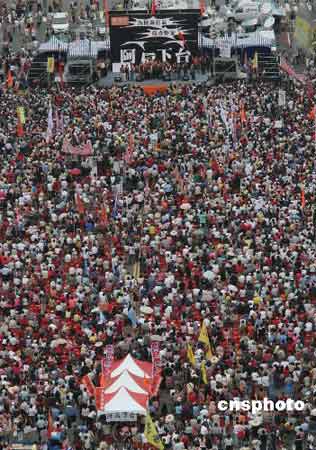

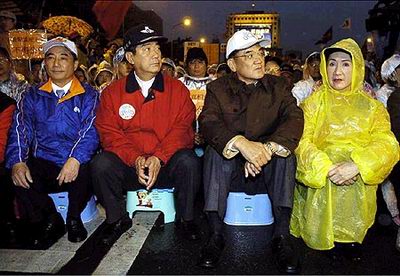
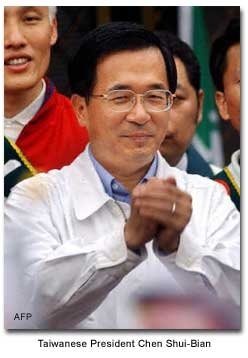
"Recall Chen" rally in Changhua


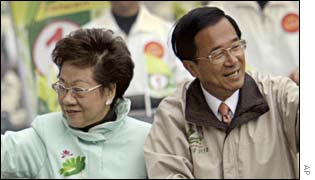
KMT Chairman Ma Ying-jeou at "Recall Chen" rally in Changhua

Published on TaipeiTimes

Ma's brazen attack on Taiwan's democracy
By Cao Chang-qing
Friday, Jun 16, 2006

Anyone without a deeper understanding of the political situation in Taiwan would be excused for thinking that President Chen Shui-bian must have violated a slew of laws to cause the pan-blue camp to call for his blood and launch a formal motion for his recall. Even Chinese Nationalist Party (KMT) Chairman Ma Ying-jeou said, mouth dripping with venom, that unless Chen steps down, the people will rise up and topple him, giving him a nasty death. "Topple" and "die a nasty death" are phrases implying violence and coups d'etat that make us think of China's Cultural Revolution, a time when the air was filled with shouts of "topple" and people were driven to "nasty deaths" on a daily basis.

Comment: After regaling us with the above purple prose lead in, Cao Chang-qing then makes two assertions, both unadulterated nonsense, legally, logically, and historically.

First, Cao asserts that because the Pan Blue camp's recall motion does not require proof that Chen is guilty of criminal wrongdoing, that constitutes proof that Chen is innocent of criminal wrongdoing.

Cao: When Ma gave his reasons for supporting the recall motion, he inadvertently told us the truth. He said that the motion to recall Chen was a "political action" and that "a violation of the law is not necessary" to support such a move. In the midst of the barrage of pan-blue accusations against Chen, this was tantamount to telling the world that Chen had not violated the law and that he was not involved in the corruption scandals; that these accusations, in effect, were political fabrications without any foundation in fact. That is the only reason why Ma, a former minister of justice with a law degree, said that "a violation of the law is not necessary," since that washes Chen clean of all criminal suspicions.

Comment: Chen Shui-bian, his immediate family, his in laws, his cronies, and his fellow ruling DPP officials, have engaged in every form of corruption known to man, including patronage, bribery, extortion, influence peddling, fraud, embezzlement, and nepotism.

Taiwan independence apologists have demanded that those outraged by prima facie evidence of ruling DPP corruption must first prove corruption by means of the criminal justice system, and if they can't, they must shut up.

But as anyone familiar with the grim reality of Taiwan's "democracy" knows, ruling DPP malfeasance includes the hijacking of the criminal justice system, or at least its upper echelons. Put simply, the ruling DPP owns the criminal justice system.

Lower echelon public prosecutors and criminal investigators are at best, coerced into passively sitting on their hands and biting their tongues, or at worst, actively persecuting whistleblowers who are exposing ruling DPP corruption.

To ask victims of ruling DPP corruption to rely on the ruling DPP's criminal justice system to protect them from ruling DPP victimization, is to ask chickens to rely on the fox to guard the henhouse.

Secondly, Cao asserts that because the Pan Blue camp's recall motion cites Chen's unfitness as a political leader, and does not require proof that Chen is guilty of criminal wrongdoing, therefore the Pan Blue camp does not respect "democracy."

Cao: This statement is a shameless attack on Taiwan's democracy. In Western democracies, there is no way to recall a head of state based on political actions ... If it were possible to recall the head of state in two-party or multi-party systems for their political actions, political views and policy differences would turn democracy into a farce where parties would take turns recalling each other's head of state -- a preposterous, unimaginable situation. Such a preposterous and unimaginable situation is currently being played out in Taiwan. The biggest opposition party has held a demonstration to incite the public, and its chairman has even said that "a violation of the law is not necessary" to recall the president, his political actions are enough.

Comment: What precisely does Cao find so "preposterous" and "unimaginable" about recalling an elected official on political, rather than criiminal grounds?

An elected official is, theoretically speaking, a public servant. When a public servant is elected, he is hired. When a public servant is recalled, he is fired.

If electing someone on political grounds is the people's inalienable right, as self-styled "champions of democracy" so shrilly insist, then why isn't unelecting someone on political grounds, i.e., recalling them, also their inalienable right?

Proof of criminal wrongdoing is not necessary to fire an elected official, nor should it be. It is enough that his employer, i.e., the people, the taxpayers, the voters, are unhappy with his job performance.

As California voters know perfectly well, in the fall of 2003, sitting Democratic Governor Gray Davis was recalled and replaced with Republican Arnold Schwarzenegger, on political rather than criminal grounds, with no apology needed.


Arnold Schwarzenegger and his wife, Maria Shriver, kiss during victory speech

As Wikipedia explains:

Backers of the recall effort cited Gray Davis's alleged "lack of leadership" combined with California's weakened and hurt economy. According to the circulated petition [Governor Davis's actions were a] "gross mismanagement of California Finances by overspending taxpayers' money, threatening public safety by cutting funds to local governments, failing to account for the exorbitant cost of the energy , and failing in general to deal with the state's major problems until they get to the crisis stage."


Gray Davis: "The people did decide that it's time for someone else to serve and I accept their judgment."

No proof of criminal wrongdoing on the part of Davis was necessary to initiate the recall, nor was any offered. Davis was recalled purely on the basis that in the subjective opinion of California voters, he wasn't doing a satisfactory job.


Are Cao and his fellow Taiwan independence apologists truly unable to deduce for themselves what procedures are or are not reasonable under constitutionalism and the rule of law?

Are Cao and his fellow Taiwan independence apologists truly unaware of what the prevailing norms are within "advanced democracies?"

Two possibilities present themselves.

One, Cao and his fellow Taiwan independence apologists know the nonsense they have spouted about the Pan Blue sponsored recall effort is untrue, in which case they are merely dishonest.

Two, Cao and his fellow Taiwan independence apologists actually think the nonsense they have spouted about the Pan Blue sponsored recall effort is true, in which case they are both stupid and ignorant.

Monday, June 12, 2006

Desperate Fear of an Honest Debate

Desperate Fear of an Honest Debate
Bevin Chu
June 11, 2006

A good rule of thumb in political debate is that you can judge the seriousness of an adversary's argument by the seriousness with which he treats yours. If he takes you seriously, it means he's pretty certain he's got you beat on the merits. But if he resorts to hyperbole, parody, and sarcasm, then he clearly fears an honest debate.
-- Eric Alterman
columnist for The Nation, regular contributor to MSNBC


Pan Blue legislators applaud the passage of a motion to recall "President" Chen Shui-bian

The Taipei Times is the English language propaganda organ for the Taiwan independence movement. Taipei Times news reports are often indistinguishable from pro Taiwan independence editorials. Taipei Times editorials meanwhile, are often indistinguishable from the ravings of streetcorner prophets.

But with their sophomorically titled, and even more sophmorically written "Taiwan, Banana Republic of China?" the editors of the Taipei Times have truly outdone themselves.

I have been writing about the Taiwan independence issue for over a decade, since the mid 1990s. I can honestly say that in all that time I have never encountered a pro Taiwan independence editorial as full of hyperbole, parody, and sarcasm as this one.


Read it and decide for yourself whether the editors of the Taipei Times believe they have the Pan Blue opposition beat on the merits of the impeachment and recall controversy, or are terrified of an honest debate?

Read it and decide for yourself whether the editorial doesn't reveal the desperation Taiwan independence spin controllers must be experiencing, more eloquently than anything a Pan Blue pundit might author?

Published on TaipeiTimes
Editorial: Taiwan, Banana Republic of China?
Friday, Jun 09, 2006

Okay, so let's imagine for a moment that, all reason having been tossed aside, President Chen Shui-bian succumbs to the demands of the opposition parties and resigns.

Such an event would mark the end of democracy in Taiwan and the beginning of mob rule. Taiwan would be left with a mockery of a political system based on the mercurial whims of the entrenched political elite. Heads of state could be selected and overthrown based on deals made in backrooms, by ever-changing alliances of different political factions.

Of course, such a system would leave the general public with little room to exercise its right to choose its leaders, but that shouldn't be a problem. Let's take a page from our comrades in Zhongnanhai. They tell the Chinese people that they aren't ready for democracy -- that it is an ugly affair, which inevitably results in chaos.

Well, aren't they correct? Isn't Taiwan chaotic, now that it is a democracy? Isn't the lawlessness of modern Taiwan terrible? Maybe it isn't exactly the anarchy depicted in the film The Road Warrior, replete with bike gangs who terrorize the populace -- but that's the logical next step, isn't it? Oh, the horror of our society. Why, one can't walk the streets at night without fear of being robbed or killed, right?

Luckily, the opposition parties are trying to do something to counteract the vicious chaos of democracy, with its hideous personal freedoms and its awful system of making the government accountable to the people.

They have devised a better system, in which government officials are held to account by other government officials. They can all keep each other honest together, because nothing is so honest as a politician. The more politicians you have, the more honesty you have -- that's the logic behind all of this.

The people need never be bothered by having to make decisions about their country or its leaders -- that's what the political elite is for. The elite is supposed to control things -- that's what makes them elite. And they should control the people, because the people don't know how to control themselves -- that's why there is so much chaos in Taiwan.

So the opposition parties can solve all of this by forcing the president out of office. They don't like him and they don't want him. And why should they? Just because he was duly elected by a majority of the voters? Just because a fundamental underpinning of democratic systems is the belief that governments exist solely by the consent of the governed?

Well, the opposition parties have shown that they believe Taiwan needs no such confusing, namby-pamby hogwash if it wants to get things done. The opposition parties have a better way -- a stronger, simpler way of dealing with the problems of governance.

The opposition parties can ensure that the people will never be upset by having to read stories about government corruption again. After all, they have decades of experience in controlling the media and persecuting critics. If a journalist wants to pester the people by talking about government malfeasance and graft, the solution is simple: shoot her.

Isn't this what the opposition parties envision for us? Can't they bring back the heady, halcyon days of orderly, calm, controlled society? Taiwan can once again grow and prosper under the loving care and stern gaze of Big Brother. Surely it's much more preferable for Taiwan to seek the safety and security of totalitarian rule.

So let's give three cheers for the opposition and their plan to squash the menace and terror of democracy.


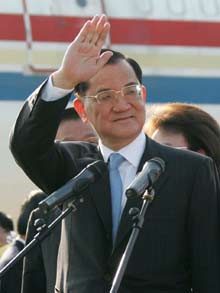
2004 President elect Lien Chan (2nd from right) and Vice President elect James Soong (3rd from right)


Illegitimate presidential and vice presidential usurpers Chen Shui-bian and Annette Lu

Comment: The truth is I'm reluctant to take too much time out to refute the Taipei Times' editorial. After all, what could I possibly say that wouldn't insult the readers' intelligence? What could I possibly say that wouldn't imply, however inadvertently, that readers couldn't see through the Taipei Times' transparent nonsense without my help?

On the other hand, some readers may be coming into this issue for the first time. These readers may be unfamiliar with Taiwan's Alice in Wonderland, Through the Looking Glass political universe, in which "mei you hei bai, zhi you lan lu" (There is no black and white, there is only blue and green). These readers may not have enough background about the presidential impeachment and recall controversy to realize that the Taipei Times' editorial is nothing more than the raucous barking of a dog that can't bite.

These readers deserve a cursory rebuttal. A cursory rebuttal however, is all that is warranted. Anything more would do these readers a disservice, giving them the mistaken impression that the Taipei Times actually presented a case at all.

In fact, the Taipei Times failed to offer a single coherent argument. Instead, it made a string of hysterical allegations and advanced a series of logical non sequiteurs totally unrelated to anything the Pan Blue opposition has said or done.

An American or European reader unfamiliar with Taiwan's politics, after reading the Taipei Times' editorial, might be forgiven for concluding that the Pan Blue opposition was a military junta about to stage a Latin American style coup d'etat and march into the Presidential Palace.

In fact, the predominantly middle class, law-abiding to a fault Pan Blue opposition has made its intentions crystal clear. The Pan Blue opposition intends to impeach or recall Chen Shui-bian, entirely within the constitutional framework of the Republic of China, in strict accordance with the Republic of China's Election and Recall Laws, even though these laws make impeachment or recall nearly impossible.

To impeach Chen, a motion must be initiated by over half of the ROC legislature, endorsed by two-thirds of the ROC legislature, then presented to the 15 member Council of Grand Justices for adjudication.

To recall Chen, a motion must be initiated by over a fourth of the ROC legislature, endorsed by two-thirds of the ROC legislature, then approved by at least half the valid ballots cast by at least half of all eligible voters in a national referendum.

As the editors of the Taipei Times are fully aware, the Pan Blue opposition by itself does not constitute a two-thirds supermajority in the ROC legislature. Without the participation of over 30 Pan Green legislators, the Pan Blue opposition does not have enough votes to recall Chen.

Even if the Pan Blue opposition manages to persuade over 30 Pan Green legislators to side with them against the ruling Pan Green kleptocracy, a successfull recall still requires an absolute majority of at least half of all eligible voters in a national referendum.

Even if the Pan Blue opposition manages to impeach or recall Chen, it has made clear it intends to recognize Chen's running mate and current "vice president" Annette Lu, as his successor.

Do the editors of the Taipei Times care to explain how having Chen's own running mate Annette Lu replace him as president, in strict accordance with the provisions of the ROC Constitution and ROC Election and Recall Laws, "marks the end of democracy in Taiwan and the beginning of totalitarian rule?"

Be aware that as a matter of law, the Pan Blue opposition is not obligated to recognize Annette Lu as Chen's successor. The Pan Blue opposition would be well within its rights to recall both Chen and Lu simultaneously. The Pan Blue opposition's decision to recall only Chen and not Lu is an act of political discretion, not a legal obligation.

Be aware that as a matter of law, Chen Shui-bian and Annette Lu should not be sitting in the Presidential Palace in the first place. Both are illegitimate usurpers.

Lien Chan and James Soong are the duly elected president and vice president of the Republic of China, having won the 2004 Republic of China Presidential Election by a 53% to 47% margin.

The only reason Lien Chan and James Soong are not currently sitting in the Presidential Palace is that the Bush II regime pulled a fast one on them. On March 27, 2004, it promised to back their demands for a new election, providing they released their political chokehold on Chen.

But once the 500,000 to 1,000,000 strong crowd of Pan Blue and independent citizens dispersed, the US government, the "world's champion of democracy," stabbed the democratic majority of ROC voters in the back, disingenuously citing the Central Election Commission's rubberstamping of Chen's "election" as the official end of the dispute.

I could painstakingly rebut each and every one of the editorial's hysterical allegations, one after another.

But is that really necessary?

By now, even readers totally unfamiliar with the Taiwan independence issue should be able to see that the Taipei Times' uncontrolled apoplexy has nothing to do with anything taking place in the real world.

The editors of the Taipei Times, by resorting to hyperbole, parody, and sarcasm, have revealed that they are in desperate fear of an honest debate.


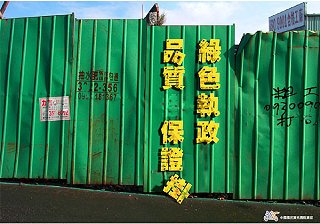
Caption: Green government, quality guaranteed ... to be inadequate

Considering the sorry plight of today's Taiwan, the result of the DPP's much touted "lu se zhi zheng, pin zhi bao zheng!" (Green government, quality guaranteed!) they should be.

Friday, June 09, 2006

DPP Rapidly Losing Political Ground

Friday, June 09, 2006
DPP rapidly losing political turf in Taipei on scandals, Shen says
2006/6/9
The China Post staff

The "pan-blue" alliance is enjoying a much higher constituency ratio than the "pan-green" camp at about 80:20, compared with the past level of 55:45, following the exposure of a spate of scandals surrounding President Chen Shui-bian's wife and son-in-law, according to ex-lawmaker Shen Fu-hsiung of the ruling Democratic Progressive Party (DPP). Shen made the remarks when delivering a speech at Shuteh University of Science and Technology in Kaohsiung, southern Taiwan, Wednesday night. Shen forecast that the number of seats at the Taipei City Council held by the DPP would drop to 12 or 13 from the existing 17, while that for the pan-blue camp would rise to 59 or 60.


DPP elder Shen Fu-hsiung, black sheep of the party

Comment: Unfortunately for the DPP, Shen Fu-hsiung is right. Unless the DPP party hierarchy wises up and listens to black sheep party member Shen Fu-hsiung, who insists that the DPP must undergo fundamental reform and reconsider what it stands for, the DPP is finished.

Shen dared to tell DPP True Believers that "The emperor has no clothes!" and had better cover itself up, PDQ. Such frankness is no longer acceptable within today's willfully blind DPP, and Shen has since become a pariah within his own party.

Will the DPP party hierachy heed Shen's advice?

No it won't.

Formally Shen is still a DPP party member, but in name only. Practically speaking, Shen is already an ex DPP party member, and has joined the ranks of ex DPP members Hsu Hsing-liang, Shih Ming-teh, Sisy Chen, and Cheng Li-wen.

The DPP was once a genuinely "democratic and progressive" political party, in which anything and everything was up for debate. But the moment it seized power in 2000, the DPP changed.

Lord Acton said: "Power corrupts. Absolute power corrupts absolutely." One is tempted to add: "Near absolute power, corrupts nearly absolutely."

What the DPP acquired in 2000, thanks to the machinations of Pan Green wolf in Pan Blue sheep's clothing Lee Teng-hui, was near absolute power. What that near absolute power did, was corrupt the DPP nearly absolutely.

That near absolute power has nearly absolutely corrupted the Taiwan independence movement, the pro Taiwan independence Democratic Progressive Party, but most of all, the unchallenged leader of both the movement and the party, Chen Shui-bian.

The DPP party hierarchy made a fateful decision with its recent joint statement, signed by DPP Chairman Yu Shyi-kun, Vice President Annette Lu, Premier Su Tseng-chang, and former premier Frank Hsieh.

On May 27, 006, these "Si Da Tian Wang" (Four Great Kings of Heaven), so-called, rallied behind Chen Shui-bian, despite everything Chen has done over the past six years. In doing so, they signed a suicide pact.

As I said in my recent article, "The DPP continues down its Suicidal Path," I welcome their decision. I mean that, in all seriousness.

Why wouldn't a Deep Blue Chinese reunificationist such as myself welcome such a strategic Pan Green blunder?

The DPP is its own worst enemy. The DPP party hierarchy's monumentally short-sighted decision will inflict more political damage upon the largest and most powerful pro independence political party than the shrewdest attempt at political subversion by any strategist within the Pan Blue camp.

The DPP party hierarchy's myopic beyond belief decision to sweep Chen's egregious shortcomings under the rug and pretend nothing is wrong, will ensure the early demise not only of the DPP as a political party, but far more importantly, of Taiwan independence as a political ideology.

Strictly speaking, Pan Blue pundits such as myself shouldn't be putting such insights out there. After all, as Napoleon Bonaparte warned, "Never interrupt your enemy while he's making a mistake."

But Deep Green political leaders are so blinded by their doctrinaire fundamentalism, nothing Pale Green DPP elders such as Shen Fu-hsiung might say or do, let alone anything detested Deep Blue New Party pundits such as myself might say or do, is ever going to persuade them to reflect upon the error of their ways.

As a result, the DPP party hierarchy will continue alienating more and more Chinese people on Taiwan.

As a result, I eagerly look forward to the outcome of the upcoming 2007 Republic of China Legislative Election.

If you thought the 2004 legislative election was a Pan Green debacle, wait til you see the returns from the 2007 legislative election.

This fall, the DPP will celebrate its twentieth anniversary.

It had better make the most of it, because at
the rate it's going, it might not be around to celebrate its twenty-first.

Tuesday, June 06, 2006

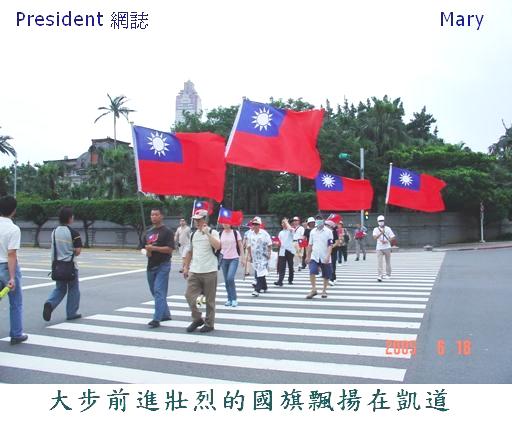
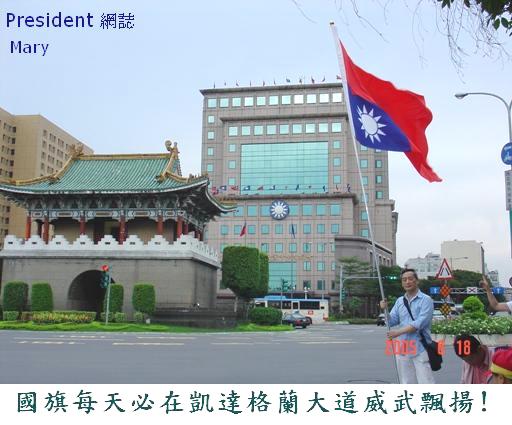
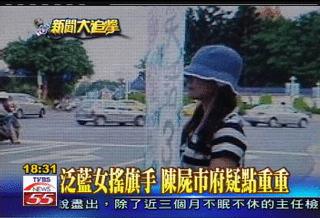
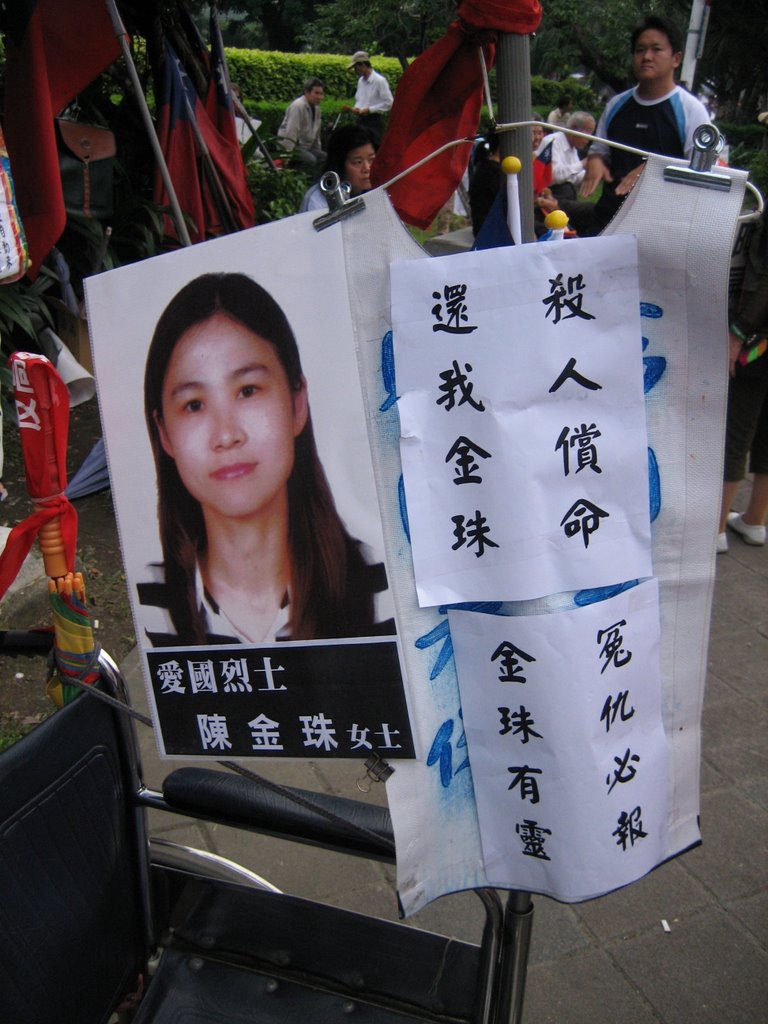
Chen Chin-chu, In Memoriam

Chen Chin-chu, In Memoriam
Bevin Chu
June 05, 2006


Rights are never lost; they are surrendered
權利只有放棄,並沒有消失
-- Chen Chin-chu 陳金珠 (1962-2006)


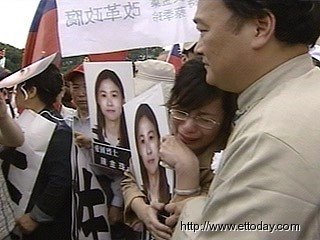
Chen Chin-chu's older sister protests her tragic and suspicious death


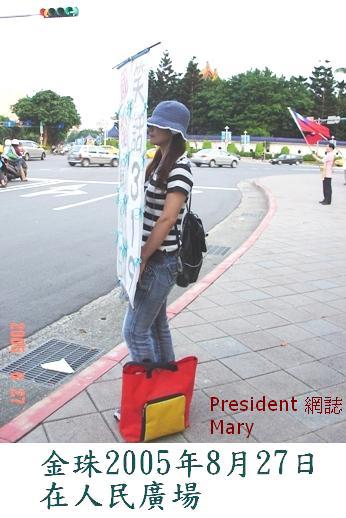
Caption: Chen Chin-chu [protests the 319 shooting hoax] at People's Square


Chen Chin-chu's fellow protestors


Another of Chen Chin-chu's fellow protestors (Note: the flag in this photo was deliberately inverted as a political statement, to indicate that the nation was in distress)


Caption: Chen Chin-chu shows bruises from police manhandling at People's Square


Caption: Female Pan Blue protestor's dead body turns up at Taipei City Hall. Questions abound.


Caption: Chen Chin-chu's body being lowered by a rope to be shipped out


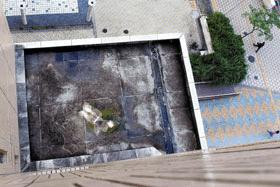
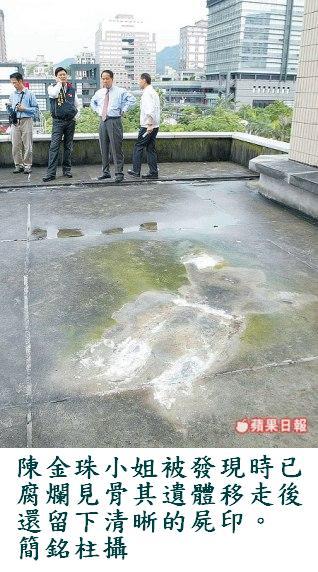
Third floor balcony at Taipei City Hall where Chen's body was found


Third floor balcony at Taipei City Hall where Chen's body was found


Third floor balcony at Taipei City Hall where Chen's body was found


Caption: When Miss Chen Chin-chu's body was found, it was so badly decomposed bones were visible and removal of her body left a clear impression


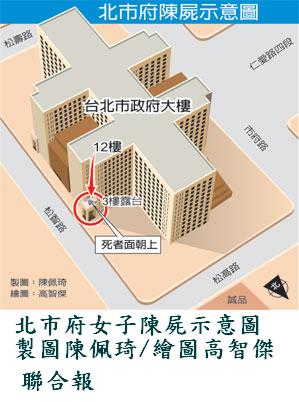
Caption: Diagram of where Chen's body was found at Taipei City Hall


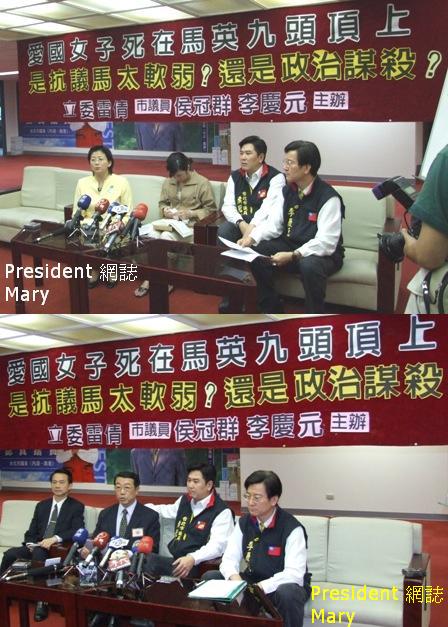
Banner: Woman patriot dies right on top of Ma Ying-jeou's head. Was she protesting Ma's weakness? Or was it politically motivated murder? Press conference convened by ROC Legislator Joanna Lei (KMT/NP) and Taipei City Councilmen Hou Kuan-chung (NP) and Lee Ching-yuan (NP)


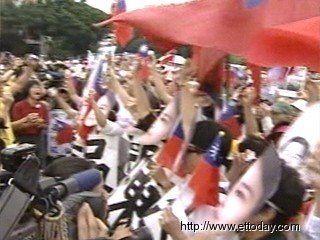
Pan Blue supporters protest on behalf of Chen Chin-chu in front of the Presidential Palace


Caption: Chen Chin-chu's family members toss white flowers in protest


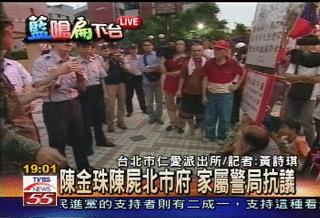
Caption: Chen Chin-chu's body turns up at Taipei City Hall. Family members protest in front of Renai Police Precinct Station


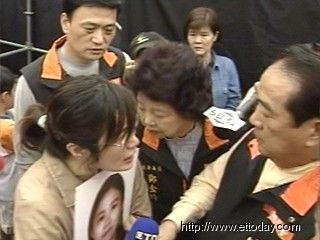
Chen Chin-chu's sister talks to PFP Chairman James Soong


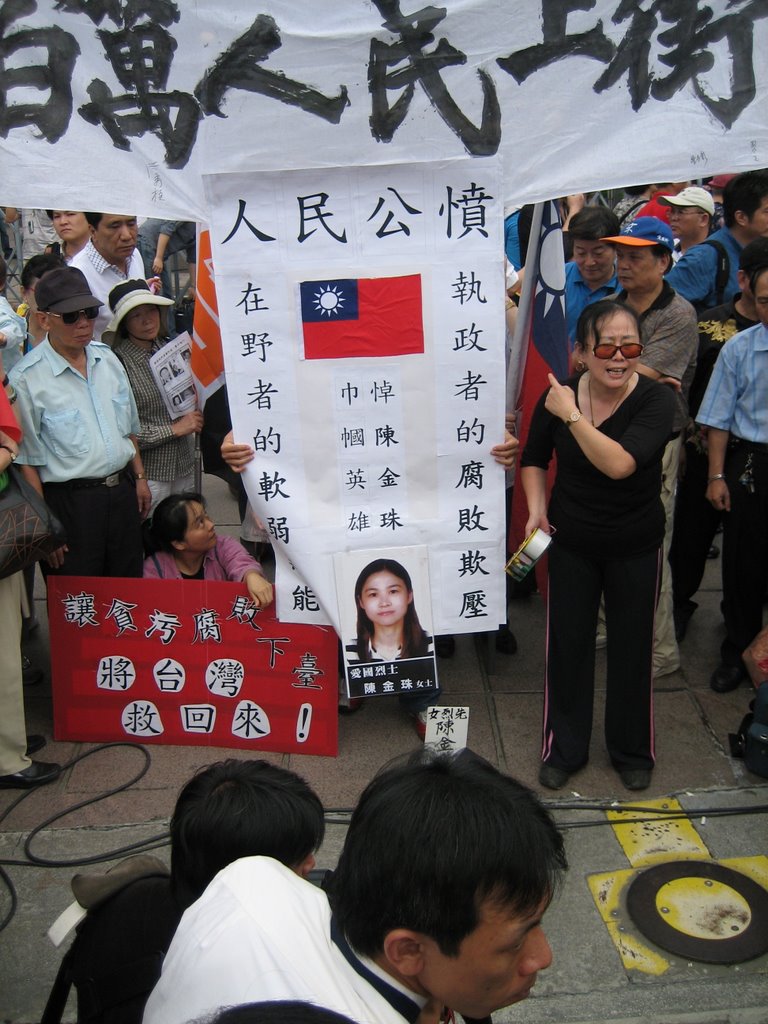
Protest banner: Public outrage. Ruling party corruption and oppression. Opposition party weakness and impotence. Remembering Chin-chu, heroine of the nation


Photo caption: Miss Chen Chin-chu, Patriot and Martyr
Protest signs: Justice for Chin-chu. Chin-chu's spirit lives on


Protest sign: Chen Chin-chu's spirit remains

Monday, June 05, 2006

The Taiwan Independence Movement's Total Contempt for the Rule of Law

The Taiwan Independence Movement's Total Contempt for the Rule of Law
Bevin Chu
June 04, 2006


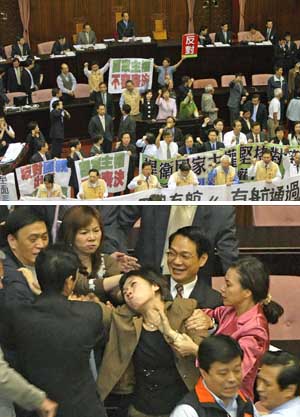
Pro independence Pan Green legislators, knowing two opposition amendments will pass, prevent a vote by means of physical violence

On May 31, 2006, pro independence legislators in the Republic of China legislature prevented the passage of two amendments that would have permitted direct airline flights and maritime shipping between the mainland region of China and the Taiwan region of China.

Pro independence legislators prevented the passage of the two amendments not by means of a democratic majority in the Republic of China legislature.

Pro independence legislators have never constituted a majority within the ROC legislature.

Pro independence legislators prevented the passage of the two amendments not by resorting to devious but legal stalling tactics.

They already exhausted that option with a failed filibuster.

Pro independence legislators prevented the passage of the two amendments by means of physical violence.

What do I mean by physical violence?

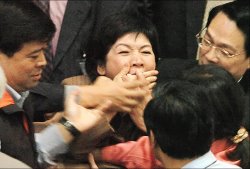
I mean that a pro independence legislator prevented the Republic of China legislature from holding a vote on the two amendments by snatching a cloture petition from a Pan Blue legislator, stuffing it into her own mouth, chewing it up, then spitting it out and tearing it to pieces.


DPP legislator Wang Shu-hui snatches the opposition's cloture petition and stuffs it into her mouth

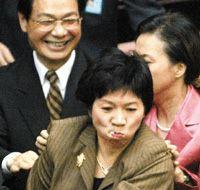
Female Democratic Progressive Party legislator Wang Shu-hui snatched the cloture petition from the hands of female People First Party legislator Ko Shu-min while Ko was was on the way to the podium to present the petition to Speaker of the Legislature Wang Jing-Pyng.

A dozen or so DPP legislators then surrounded Ko, preventing her from reaching Wang and retrieving the petition.

Wang stuffed the document in mouth to prevent Ko and other PFP legislators who rushed to Ko's aid from retrieving it.

Wang chewed on the petition, mutilating it. She later spat it out and tore it into tiny pieces.


DPP legislator Wang Shu-hiu destroys the opposition's petition by chewing on it

Cloture, for the record, is a parliamentary procedure by which debate is ended and an immediate vote is taken on the matter under discussion. It is also called closure.

The cloture motion would have ended the DPP's fillibuster and enabled a vote on two amendments to the Statute Governing Relations between the People of the Taiwan Area and the Mainland Area.

Article 28 of the Statute Governing Relations between the People of the Taiwan Area and the Mainland Area forbids airplanes and ships from traveling directly to the mainland unless specifically authorized by the government. Mainland airplanes and ships are barred from Taiwan's territorial waters and air space, unless explicitly allowed by Taipei authorities.

The two amendments would have lifted the ban and required the government to allow direct flights and shipping within three to six months. The government would have had to draft a set of regulations enabling direct that period of time.

DPP Legislative Caucus Whip Ker Chien-ming said the DPP would never agree to vote on the two amendments. DPP legislator at large and former premier Chang Chun-hsiung insisted that "Taiwan's sovereignty [sic] is at stake."

The Republic of China Legislature was then forced by procedural rules to go into summer recess.

Will somebody please provide the "Democratic Progressive Party" and the Taiwan Solidarity Union with copies of The Common Law of Parliamentary Procedure and Robert's Rules of Order?


Robert's Rules of Order, circa 1876

Not one Taiwan independence legislator, not one Taiwan independence elder, not one Taiwan independence academic, not one Taiwan independence pundit has spoken out against this outrage against the rule of law.

From this day forward, I never want to hear another "champion of democracy," especially western expatriate Taiwan independence fellow travelers on Taiwan, lecture the Chinese people about "democracy, freedom, human rights, and the rule of law."

clo·ture
Pronunciation (klchr)

n. A parliamentary procedure by which debate is ended and an immediate vote is taken on the matter under discussion. Also called closure.

tr.v. clo·tured, clo·tur·ing, clo·tures

To apply cloture to (a parliamentary debate).

[French clo^ture, from Old French closture, probably alteration of closure, closure; see closure.]

This article draws on information provided by the English language China Post.

Thursday, June 01, 2006

"President" relinquishes Nonpresidential Powers

"President" relinquishes Nonpresidential Powers
Bevin Chu

May 31, 2006


Chen Shui-bian, pretender to the Presidency of the Republic of China

One of the essential abilities that any intellectual worthy of the name must possess, is the ability to see what is right under one's nose. This includes the ability to read a news report or op ed piece, and catch any paradoxes "hiding in plain sight" within the news report or op ed piece.

The ability to catch such paradoxes is an a priori deductive ability not dependent upon prior empirical knowledge. Whoever
develops this ability can extract valuable information from an article, even if one knows nothing about the subject being covered or analysed in advance.

These paradoxes, which often go unnoticed even by the journalist or pundit who authored the article, are often the most valuable points in the news report or op ed piece.

Consider for example, the following articles. The first is a news report from Bloomberg, the second is a think piece from Stratfor.

First, let's look at the news report from Bloomberg:

Taiwan President Chen Delegates Some Powers to Cabinet, Premier

James Peng in Taipei
June 1 (Bloomberg)
Last Updated: May 31, 2006 19:05 EDT

Taiwan President Chen Shui-bian said he will delegate some powers to the Cabinet and premier after his son-in-law was detained last week by prosecutors investigating insider trading, a Presidential Office spokesman said.

``President Chen made the decision late last night and the announcement was issued via the state-owned Central News Agency,'' spokesman David Lee said in a telephone interview today in Taipei. The agency issued the report about 11 p.m. last night.

Chen will retain powers granted him by constitution, Lee said. He is still the military's commander-in-chief of the military and remains in charge of foreign, defense and China policy, the spokesman said.

Comment: Now let's look at the think piece from Stratfor, aka Strategic Forecasting.

Stratfor
Taiwan: Chen Relinquishes Nonpresidential Powers
May 31, 2006 20 34 GMT

Summary

Taiwanese President Chen Shui-bian announced late May 31 that he is transferring power to the premier and ruling party chief in the wake of the scandal over his son-in-law's alleged insider trading. This removes him from his Democratic Progressive Party (DPP) -- distancing him from both internal rifts and the DPP's battles with the opposition Kuomintang -- and separates the DPP from the scandal.

Analysis

Taiwanese President Chen Shui-bian has been under increasing pressure since his son-in-law was implicated in an insider trading scandal. He already was suffering from a growing legitimacy crisis, as his push for independence has hurt business interests in Taiwan.

Opposition parties, including the Kuomintang (KMT), are trying to implicate the president in the scandal in hopes of allowing the KMT to begin impeachment proceedings. Under this increasing pressure, and with public opinion polls plummeting to the mid-teens (and the KMT already assumed to take the leadership in the next elections), Chen on May 31 relegated [sic] presidential administrative duties and personnel appointments to the premier and handed over his leadership role in the Democratic Progressive Party (DPP) to the ruling party chief. In essence, he is no longer acting as head of government, but only as head of state. He has not resigned as president but has decided to act only within the strict constitutional definition of presidential roles.

Now that Chen has relinquished his ties to the DPP, the party stands a chance of regaining some ground before local elections in December, which includes the elections for the mayoral post in Taipei. Chen hopes to divert his family's scandals from the DPP and from KMT condemnation, while giving himself more time and space to deal with the accusations.

Chen knows that he has been rendered useless in his current position and needs to change things radically. If Chen is implicated in the scandal involving his son-in-law, there is no doubt that the KMT will begin impeachment proceedings. Although Chen's move will take some pressure off the DPP, if he is able to remain in power he will continue to be a lame-duck president. However, by relinquishing his nonpresidential powers now, Chen might salvage some vestige of respect for his pro-independence party and keep the DPP from sacrificing him in the scandal.

Comment: Did you catch the paradox contained in both the news report and op ed piece? Did you catch the most valuable point of both the news report and op ed piece?

As the Stratfor headline wittingly or unwittingly implied, the most valuable point of both the Bloomberg news report and the Stratfor think piece was that a "president" was relinquishing nonpresidential powers.

Think about what that means for a moment.

That means that prior to relinquishing nonpresidential powers, that "president" had been exercising nonpresidential powers.

That means that prior to relinquishing nonpresidential powers, that "president" had usurped nonpresidential powers.

Political scientists and constitutional law experts have a term for a chief executive who usurps and exercises powers not constitutionally delegated to him, or her. That term is "dictator." More ancient terms are "despot" or "tyrant."

As the Bloomberg news article noted, in the words of Chen's own flunky, David Lee:

"Chen will retain powers granted him by constitution ... "

That means Chen had seized powers not granted him by the constitution.

As the Stratfor think piece noted:

"In essence, he is no longer acting as head of government, but only as head of state. He has not resigned as president but has decided to act only within the strict constitutional definition of presidential roles."

That means Chen had been acting as both head of government and head of state.

That means Chen had been acting outside the strict constitutional definition of his presidential role.

That means that Chen was guilty of gross constitutional violations and should have been impeached or recalled for these offenses alone.

The fact that he is also guilty of every conceivable form of corruption under the sun, including patronage, bribery, extortion, influence peddling, fraud, embezzlement, and nepotism,
is merely, as the Chinese expression goes, "frost on top of the snow," i.e., "insult added to injury."

As I said, the ability to read an article and catch any paradoxes "hiding in plain sight," is of inestimable value. One who possesses this ability can extract valuable information from the article, even if one knows nothing about the subject being covered or analysed in advance.

Of course, those armed with additional, empirical knowledge not mentioned in the above news report and think piece will be aware of an even more fundamental fact, namely that Chen Shui-bian is not the president of the Republic of China in the first place.

I don't use scare quotes around the title "President" when referring to Chen Shui-bian out of contrariness.
I use them because they reflect the legal reality. I use them because Lien Chan is the duly elected president of the Republic of China.

For more on this subject, see my 2004 articles on the 2004 Republic of China Presidential Election


Lien Chan, the duly elected President of the Republic of China

Not only has Chen Shui-bian exceeded the powers of the presidential office, the powers of the presidential office weren't even his to exceed.

Sunday, May 28, 2006

The DPP continues down its Suicidal Path

The DPP continues down its Suicidal Path
Bevin Chu
May 28, 2006

In a previous article, "The Beginning of the End, Part VI: The DPP commits Political Suicide," I said that in order to save their political party, the DPP party hierarchy must demonstrate "the vision thing." They must jettison the corrupt, opportunistic Chen, who has run the party's image into the ground. They must forsake Chen's discredited Taiwan independence agenda, which has bankrupted the island's economy. They must embrace former DPP chairman Hsu Hsing-liang's "Da Dan Xi Jing" (Bold Advance Westward), the "West" in this case meaning the Chinese mainland. The DPP party hierarchy knows what it must do, not only to save their political party, but also to save Taiwan.

What has the DPP party hierarchy done?

Nothing.

The overwhelming majority of the DPP's party hierarchy has defaulted on the solemn responsibility of challenging Chen. Lacking the courage to "Speak Truth to Power," they have chosen their own short-term political survival over their party's long-term political fortune. In doing so, they have all but sealed the fate of both the DPP and the Taiwan independence movement. The DPP has committed political suicide.

That was in January 2006. It is now May 2006, and guess what?

Nothing has changed.

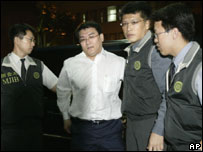
Despite the fact that the Taiwan Development Corporation scandal has finally, belatedly, led to the arrest of Chao Chien-ming, "president" Chen Shui-bian's son in law, on charges of insider trading, the DPP party hierarchy still refuses to face the ugly truth.


Chen Shui-bian's son in law, Chao Chien-ming

The ugly truth is that the purportedly "democratic and progressive" DPP has become more corrupt, autocratic and reactionary after a mere six years in power than the much maligned KMT after sixty.

The DPP party hierarchy has not only refused to face the ugly truth, it has formally declared "My president, right or wrong. My party, right or wrong. My ideology, right or wrong."

Don't believe me? Then read on.

DPP caucus promises to support Chen
Published on TaipeiTimes
Saturday, May 27, 2006

The Democratic Progressive Party (DPP) and its legislative caucus yesterday unanimously vowed to back President Chen Shui-bian and said they would work together to assist the president in stabilizing the political situation, in the wake of the president's son-in-law Chao Chien-ming's suspected involvement in an insider trading scandal.

As the DPP's reputation and image have been severely tarnished by the scandal, about 30 DPP lawmakers met yesterday to discuss how to heal the party's wounds and halt the emerging split between DPP factions.

After the two-hour meeting, faction leaders held a press conference at the Legislative Yuan to state that they would unite to rebuild people's trust in the DPP and they would try their best to assist the president to get through his current difficulties.

Translation: The DPP party hierarchy will try to sweep the dirt under the rug, put on a happy face, and go on with business as usual.

Taipei Times: Another caucus whip Chen Chin-jun urged DPP members not to be so eager to draw a line between themselves and the president.

"The only solution to the current predicament is to be more united than before. We don't think it is helpful to blame everything on the president," Chen Chin-jun said.

Translation: "You're all accomplices, your hands are as dirty as A-Bian's, so don't think you can get out of this by dropping the dime on A-Bian and singing like canaries."

Taipei Times: The DPP yesterday also issued a public letter signed by DPP Chairman Yu Shyi-kun, Vice President Annette Lu, Premier Su Tseng-chang, and former premier Frank Hsieh, urging all party members to remain calm and united and saying that the DPP will not let them down when eradicating corruption.

Comment: For passionate advocates of Chinese reunification such as myself, the fact that every one of the DPP's leading lights signed such a shameful statement is a positive phenomenon. It means that Taiwan independence leaders have decided that their own short term political advantage is more important to them than the survival of the DPP or the Taiwan independence movement.

The DPP party hierarchy has no chance whatsoever of salvaging the credibility of their one time political star Chen Shui-bian. Chen himself has seen to that. For the past six years, Chen has been busy emptying out the island's coffers, transferring Republic of China taxpayers' hard-earned wealth into the personal accounts of Taiwan's Quisling nomenklatura, including of course, the "First Family." That is one of many reasons Chen's approval rating has fallen to 5.8%, according to a poll conducted by DPP's Pan Green ally, the Taiwan Solidarity Union.


"President" Chen Shui-bian, feeling the heat

The DPP party hierarchy has little if any chance of salvaging the credibilty of the DPP as a political party, and of Taiwan independence as a political ideal. The DPP party hierarchy itself has seen to that. For the past six years, the DPP party hierarchy has been Chen's accomplice in wholesale Pan Green looting of the Republic of China treasury. Even those who did not actually pocket any booty themselves, are nevertheless guilty of aiding and abetting those who did. Even those who are legally innocent, are morally culpable.


Chao Chien-ming with mother in law and "First Lady" Wu Shu-cheng, the Lady MacBeth of Taiwan

The only chance, if any, that the DPP party hierarchy has of salvaging the DPP as an organized political force, and Taiwan independence as a persuasive political movement, is to draw a clear line between the party and the movement on the one hand, and Chen Shui-bian on the other.

Substantively speaking of course, this is impossible. From the viewpoint of justice, they deserve to go down with Chen Shui-bian.

From the viewpoint of public relations damage control however, they might be able to salvage what remains of their miserable political careers, but only if they get down on their knees and tearfully declare that "I once was lost but now am found, was blind, but now I see."

As we can seen, they have chosen not to. They have chosen not to for two reasons.

One, they are too greedy. Two, they are too cowardly.

Despite a handful of public prosecutors who have recently found the gumption to do what all one thousand of the ROC's public prosecutors should have done years ago, Chen Shui-bian still has a near total lock on the machinery of the central government. Therefore he can still dangle a carrot before the DPP party hierarchy's collective nose, and bring a stick down on the DPP party hierarchy's collective rear.

The DPP party hierarchy and the Taiwan independence nomenklatura have decided therefore that "The only solution to the current predicament is to be more united than before."

The DPP party hierarchy and the Taiwan independence nomenklatura will pay for their myopic decision. They will go down with Chen Shui-bian, as they deserve to, and justice will be served.

Saturday, May 27, 2006

Latter Day Colonialists

Published on TaipeiTimes
Letter: Chen deserves our support
By Peter Dearman
Friday, May 26, 2006

As I sat watching President Chen Shui-bian’s son-in-law taken away by police for alleged insider trading, I couldn’t help but notice how much it looked like a Hollywood paparazzi shootout. The flashes were going off so fast it had a stroboscopic effect. I couldn’t help but think that freedom of the press is taken to the extreme here in Taiwan.

This reminded me how I find it ironic that Chen is cast by his enemies as some sort of autocratic manipulator of democracy. Why then, after six long years of being assailed in the press, hasn’t he tried to suppress it just a little? Indeed, for all his arguable failures of leadership, can it be said honestly that he’s ever done anything against the spirit of democracy? Even if you believe he committed electoral fraud through a staged assassination attempt, I would say to you, why then, has he not been caught cheating at anything else? If he has such control over his minions that he can pull off repeated conspiracies (until now), why would he allow his in-laws to get involved in such an ill-conceived investment scheme? Would he not protect his own daughter better if he were the all-controling Godfather his pan-blue opponents make him out to be?

For me, the fact that Chen recently polled an approval rating below 6 percent indicates most of the population can’t recognize a good man when they see one. His vanishing support reminds me of rats deserting a ship. As for Chao Chien-ming, I hope he is kept under safe observation. If I had caused as much trouble to Chen, I worry what I might do to myself.

Peter Dearman
Taipei

Comment: I started to write a point by point rebuttal of the above letter, sent to the editors of the Taipei Times by a western expatriate Taiwan independence fellow traveler living on Taiwan.

But then I recalled the sound advice I offered readers of my column in my own article, How to Read the Taipei Times. At which point I caught myself and realized that a point by point rebuttal would be nothing but a waste of time and energy.

Anyone who has found his way to The China Desk and is reading this weblog entry is probably sufficiently well-informed about Taiwan to know that the above reader's letter to the Taipei Times is a mind-boggling joke.

Either the reader is utterly sincere, in which case the famous
quotation from Jonathan Swift comes to mind: "There are none so blind as those who will not see."

Or else the reader is flagrantly dishonest, in which case the almost as famous quotation from comedian Richard Pryor comes to mind: "Who ya gonna believe? Me or your lying eyes?"

No, I'm not going to bother with a point by point rebuttal. Not when even lifelong Pan Green leaders have openly conceded that the Chen regime, the DPP, and the Taiwan independence movement have utterly discredited themselves.

Frankly, I would prefer that Taiwan's Quisling nomenklatura seek refuge in the rationalizations offered by western expatriate Taiwan independence fellow travelers such as the above reader of the Taipei Times.

As Napoleon Bonaparte wrly advised, "Never interrupt your enemy when he is making a mistake."

Far be it for me to interrupt my enemy when he is making the mistake of a lifetime. By all means, keep making your mistake, with my blessing.

Instead, allow me to call everyones' attention to an attitude all too prevalent among western expatriates on Taiwan, one betrayed by the above reader's remark:

"For me, the fact that Chen recently polled an approval rating below 6 percent indicates most of the population can’t recognize a good man when they see one."

Did you get that?

So much for these western expatriates' insistence that "Beijing must respect the democratic will of the people on Taiwan! "

Where is their respect for the democratic will of the Chinese people on Taiwan?

So much for these western expatriates' ritual lip service to the democratic universalist article of faith: "Vox populi, vox dei." (The voice of the people is the voice of god.)

What these western expatriates really mean when they preach "freedom and democracy," is that the voice of white western colonial overlords from the "civilized" First World be treated as the voice of god.

Scratch a "Champion of Democracy," and you will find an elitist. Scratch a
western expatriate "Champion of Democracy" on Taiwan, and you will find a colonialist, a contemporary version of the pathetic yet pompous British colonialist so deftly satirized in Somerset Maugham's short stories about expatriate life in the tropics.

No. Point by point rebuttals are pointless. My response to these supercilious latter day colonialists is:

"Do you really have nothing better to do? Go home. Get a life. And allow the Chinese people to live their own."

Wednesday, May 24, 2006

E pluribus unum

Published on TaipeiTimes
Taiwan Quick Take: Independence groups unite
Tuesday, May 23, 2006


Four pro-independence societies said over the weekend they would integrate with several like-minded groups to form a "Taiwan Society" to promote social and political reform. Officials from the Northern, Southern, Central and Eastern Taiwan Societies said they had decided to break down the geographical barriers, and the four societies would instead serve as a platform for efforts to link up with more groups at home and overseas to form the "Taiwan Society." The society is scheduled to be formally launched in Taipei on June 18, with former president Lee Teng-hui to address the inaugural meeting.


Comment:
I can't be the only one who has noticed the delicious irony.

Think about it. Four pro-separatist groups, the Northern, Southern, Central and Eastern Taiwan Societies decide to "break down geographical barriers," after coming to the realization that only "in unity there is strength."

Maybe they can adopt the motto "E pluribus unum?"


Great Seal of these United States of America

According to Wikipedia:

E pluribus unum was the first national motto of the United States of America. Translated from Latin, it means "From many, one" or "Out of many, one," or in a direct translation, "One out of more." It referred to the integration of the 13 independent colonies into one united country, and has taken on an additional meaning, given the pluralistic nature of American society from immigration. The motto was selected by the first Great Seal committee in 1776, at the beginning of the American Revolution. Pierre Eugene DuSimitie're originally suggested E pluribus unum as the motto.

Now all that remains is for them to break down one more geographical barrier, the Taiwan Strait.

Former president Lee Teng-hui is scheduled to deliver an inaugural address. I have a number of quotes he might want to use, and after using them, contemplate their deeper meaning.

Behold they are one people, and they all have the same language. And this is what they began to do, and now nothing which they purpose to do will be impossible for them.
-- Genesis 11:6

Behold, how good and how pleasant it is for brothers to dwell together in unity.
-- Psalms 133:1

What ever disunites man from God, also disunites man from man.
-- Edmund Burke

Men's hearts ought not to be set against one another, but set with one another, and all against evil only.
-- Thomas Carlyle

We must all hang together, or assuredly we shall all hang separately.
-- Benjamin Franklin

One country, one constitution, one destiny.
-- Daniel Webster

The deeper meaning of these quotes is that the real barrier is not geographical. The real barrier is psychological.

The real barrier is not the Taiwan Strait. The real barrier is the psychological barrier in the Taiwan independence nomenklatura's hardened hearts, between those they insist on defining as "us" and those they insist on defining as "them," between those they insist on defining as "Taiwanese, not Chinese" and those they insist on defining as "Chinese, not Taiwanese."


We human beings face a common threat to our survival, the vagaries of nature. As I noted in my previous posting, "A Real rather than Imaginary Threat," the nations of the world ought to unite against this common threat, rather than perceiving each other as threats.

As Benjamin Franklin astutely observed, "We must all hang together, or assuredly we shall all hang separately."

Franklin's words were
admittedly uttered in a different context. Nevertheless they remain remarkably apropos.

Tuesday, May 23, 2006

What, Me Worry?

What, Me Worry?
Bevin Chu
May 22, 2006


What, me worry?

Do I need to say more?

Saturday, May 20, 2006

A Real rather than Imaginary Threat

A Real rather than Imaginary Threat
Bevin Chu
May 19, 2006

Neoconservative China Threat theorists responsible for America's strategic policy are determined to cast a non-aggressive, free market oriented China as a "New Evil Empire," and the long-suffering Chinese people as 21st century counterparts of Genghis Khan's Mongol hordes. Their "China Threat" is an imaginary, rather than real threat. Other threats meanwhile, such as space rock hitting the earth, are real rather than imaginary threats. 

Space rock could hit Earth in April 2036, say experts
Knight Ridder 2006-05-16
By Michael Cabbage

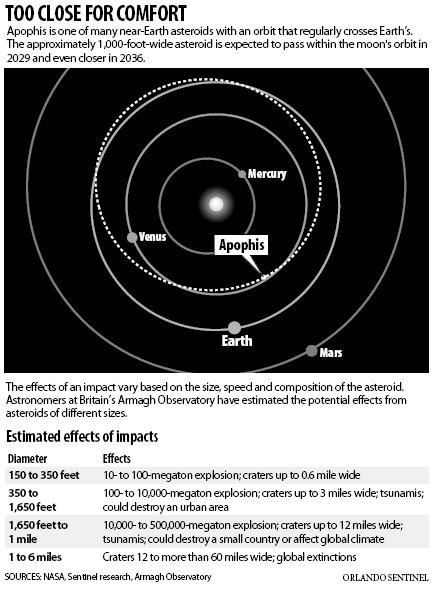
Mark your calendar for Sunday, April 13, 2036. That's when a 1,000-foot-wide asteroid named Apophis could hit the Earth with enough force to obliterate a small state. The odds of a collision are 1-in-6,250. But while that's a long shot at the racetrack, the stakes are too high for astronomers to ignore. For now, Apophis represents the most imminent threat from the worst type of natural disaster known, one reason NASA is spending millions to detect the threat from this and other asteroids. A direct hit on an urban area could unleash more destruction than Hurricane Katrina, the 2004 Asian tsunami and the 1906 San Francisco earthquake combined. The blast would equal 880 million tons of TNT or 65,000 times the power of the atomic bomb dropped on Hiroshima. Objects this size are thought to hit Earth about once every 1,000 years, and, according to recent estimates, the risk of dying from a renegade space rock is comparable to the hazards posed by tornadoes and snakebites. Those kind of statistics have moved the once-far-fetched topic of killer asteroids from Hollywood movie sets to the halls of Congress. "Certainly we had a major credibility problem at the beginning, a giggle factor," said David Morrison, an astrobiologist at NASA's Ames Research Center in California. "Now, many people are aware this is something we can actually deal with, mitigate and defend against."  

Deflecting threats 

In 1998, lawmakers formally directed NASA to identify by 2008 at least 90 percent of the asteroids more than a kilometer wide that orbit the sun and periodically cross Earth's path. That search is now more than three-quarters complete. Last year, Congress directed the space agency to come up with options for deflecting potential threats. Ideas seriously discussed include lasers on the moon, futuristic "gravity tractors," spacecraft that ram incoming objects and Hollywood's old standby, nuclear weapons. To help explore possible alternatives, former Apollo astronaut Rusty Schweickart has formed the B612 Foundation. The organization's goal is to be able to significantly alter the orbit of an asteroid in a controlled manner by 2015. "You can watch all of the golf on television you want, but if you want to go out and break par, it's going to take a lot of playing," Schweickart said. "And you're going to learn a lot that you thought you knew, but you didn't." 

Throughout their 4.5 billion-year history, Earth and its neighboring planets have been like sitting ducks in a cosmic shooting gallery. A glance at our moon shows the scars left by countless collisions with asteroids and comets. In fact, the moon is thought to have been created when part of the early Earth was ripped away in a cosmic impact with an object the size of Mars. Earth also has scars, but most have been hidden by vegetation or eroded by geologic processes such as rain and wind. About 170 major impact sites, including northern Arizona's 4,000-foot-wide Barringer Crater, have been identified around the globe. 

Alvarezes' research 

Within the past century, an extraterrestrial chunk of rock about 200 feet wide is thought to have caused a 1908 blast near Tunguska, Siberia, that leveled 60 million trees in an area the size of Rhode Island. Researchers theorize the object exploded four to six miles above the ground with the force of 10 million to 15 million tons of TNT. Few outside scientific circles took the threat posed by near-Earth objects seriously until 1980. Then, Luis and Walter Alvarez published a study based on geologic evidence that concluded a cataclysmic asteroid or comet impact 65 million years ago caused the mass extinction of two-thirds of all plant and animal life on Earth, including the dinosaurs. Dubbed the Great Exterminator, the colossal object was estimated at 7 miles in diameter and created a blast hundreds of millions of times more destructive than a nuclear weapon. 

Objects that size are thought to hit Earth about every 100 million years. NASA scientists studying satellite photos bolstered the Alvarezes' theory with the discovery in 1991 of an impact crater 125 miles wide buried beneath the northwestern corner of Mexico's Yucatan Peninsula. Three years later, NASA photos of another sort drove home the potential for cosmic collisions in our part of the solar system. Spectacular images from the Hubble Space Telescope of Comet Shoemaker-Levy's collision with Jupiter showed 21 comet fragments, producing colossal fireballs that rose above the giant planet's cloud deck. "I think the most important development for getting this (public awareness) going was the Alvarezes' research that the dinosaurs went extinct as the result of an impact," Morrison said. "We were faced with a real example where an impact had done terrible damage." 

In 2029, the asteroid will come closer to our planet than the television and weather satellites that beam back signals from 22,300 miles above. Astronomers' big fear is that Apophis will pass through a gravitational "keyhole" that will put it on a collision course with Earth in 2036. "For all practical purposes, it (a mission) would have to be done before the 2029 flyby to take advantage of the leverage afforded by that encounter," said Steve Chesley, an astronomer in the Near Earth Object Program. "That means the 2036 impact needs to be addressed by 2026."


Orbit of Near Earth Asteroid Apophis Comment: 

Neoconservative China Threat theorists responsible for America's strategic policy are determined to cast China as a "New Evil Empire," and the Chinese people as Genghis Khan's Mongol hordes. Any sign that the Chinese people are making economic, but particularly scientific and technological progress, is cited as alarming evidence of Barbarians at the Gates and Apocalypse Now.


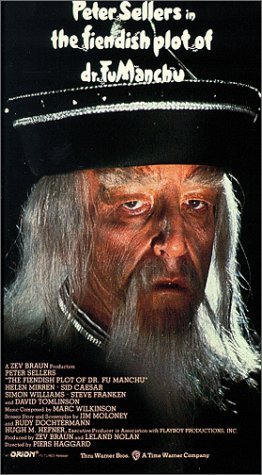
The Fiendish Plot of Dr. Fu Manchu  

The China Threat theorists' anxieties are not reflections of any real world Fiendish Plot of Dr. Fu Manchu against the "democratic west." The China Threat theorists' anxieties are psychological projections of the Malevolent Global Hegemonists' disowned shadow onto a convenient external screen. As Wikipedia explains, Psychological projection (or projection bias) can be defined as unconsciously assuming that others have the same or similar thoughts, beliefs, values, or positions on any given subject as oneself. According to the theories of Sigmund Freud, it is a psychological defense mechanism whereby one "projects" one's own undesirable thoughts, motivations, desires, feelings—basically parts of oneself—onto someone else (usually another person, but psychological projection onto animals, inanimate objects - even religious constructs - also occurs). The principle of projection is well-established in psychology. Peter Gay describes it as "the operation of expelling feelings or wishes the individual finds wholly unacceptable—too shameful, too obscene, too dangerous—by attributing them to another." 

I touched on this phenomenon in my 1999 essay, Hollywood's Tibet, in which I pointed out how Hollywood celebrities desperate to be perceived as Politically Correct have projected America's collective guilt over its treatment of American Indians onto China. Psychological projection however, is hardly confined to the Beautiful People in Hollywood. It is if anything, even more commonplace among the Political Class in Washington. China Threat Theory at its root, is the Benevolent Global Hegemonists' projection of their own malevolent desire for global hegemony onto a strange and exotic people. You know, those mysterious heathens with yellow skin and slanted eyes, always scurrying about, speaking in strange tongues, plotting who knows what against white European civilization.  

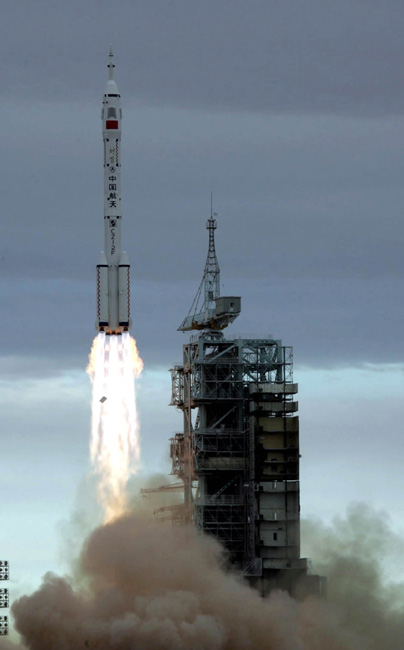
China Threat Theory, when one stops to think about it calmly and objectively, has no basis in reality. Even Australia, which is far closer to China than the US, and strategically far more vulnerable, considers the China Threat Theory sheer poppycock. Objectively speaking, what is there to fear about China's recent progress? Objectively speaking, nothing whatsoever. China's progress is an integral part of mankind's progress. China's progress doesn't benefit only the Chinese people. China's progress, like America's progress, like Europe's progress, like Russia's progress, like India's progress, benefits mankind as a whole. That progress includes China's astonishingly rapid advances in aerospace technology. 


China launches Shenzhou 6 

In the science fiction thriller Armageddon (1998, directed by Michael Bay, written by Robert Roy Pool, Jonathan Hensleigh, starring Bruce Willis, Ben Affleck, Liv Tyler) an asteroid the size of Texas threatens to destroy the planet earth. Only the combined resources of US and Russian space technology succeed in saving all life on earth, including the human race, from extinction.


Armageddon  

Armageddon was a terrible movie, but according to respected scientists the movie's premise, that life on earth might one day be extinguished by a stray asteroid, is entirely likely. According to reputable astronomers the asteroid Apophis may well pose a threat to earth in 2036, a mere 30 years from now. Suppose for the sake of argument that the China Threat theorists have their way. Suppose they succeed in using Taiwan independence as a pretext to launch a "preventive" war of aggression against a peacefully developing China. Suppose they "win" such a war. Suppose they succeed in their quest to "contain China" and set China's development back 30, 40, even 50 years. 

What then? What will Neoconservative China Threat theorists do when another Great Exterminator hurtles toward earth, and they realize too late that crucial Chinese space technology, complementing US and Russian space technology, might have been able to intercept an asteroid or comet and ensure the survival of the human race, including 290 million Americans? Anyone who snorts at such a suggestion, on the contemptuous assumption that "China doesn't rate," has either forgotten China's countless contributions to world civilization, or was woefully ignorant of them in the first place. 

 As Professor Robert Temple, a British historian and archeologist notes: People often speak of the modern world in which we live, and presume that it is a creation of the Western world. But this is not correct. More than half of the basic inventions and discoveries which led to the creation of this modern world are Chinese, and are not Western at all. Indeed, China has produced more fundamental inventions and discoveries than the rest of the world put together. Because so few people realize this, the view of China's place in the modern world is wrongly conceived. 

Most people in both East and West believe that China is emerging into the modern world. But China is not emerging into anything, it is re-emerging into something which it helped to create in the first place. Nor is China a developing country: it is a re-developing country. For two thousand years, China was developed while most of the rest of the world was undeveloped. It was richer, it was stronger, it was bigger, it could feed itself better, it could build more things of greater magnitude, and it could explore when it wanted to. 

See: http://thechinadesk.blogspot.com/2002/01/modern-world-joint-creation-of-china.html 

The US government is squandering astronomical sums that American taxpayers can ill afford, to wage a nominally defensive, but in fact offensive war of aggression against China. In doing so, it is forcing the PRC government to respond by diverting sums mainland Chinese taxpayers can ill afford, into defending China's territorial integrity from the American Empire. The so-called China Threat is an imaginary rather than real threat. A killer asteroid, once thought of as nothing but grist for the science fiction movie mill, is a real rather than imaginary threat. Instead of pretending that it is defending America against a non-existent China threat, the US government should facilitate private sector cooperation between American and Chinese scientists and engineers to defend America, China, and the rest of the world from a scientifically verifiable threat of annihilation from outer space.