Tiaoyutai (Diaoyutai) is Chinese Territory!
Fung Hu-hsiang, Ph. D., Member of the Legislature, ROC
Translated by Bevin Chu
September 28, 1996
Tiaoyutai (Diaoyutai) is Chinese Territory!
The Evidence is Beyond Dispute
1. Imperial Chinese "Envoy Chen Kan's Lui Chiu Chronicles" circa Ming Dynasty Chia-ching 13 (1534 A.D.) proves that the Tiaoyutai Islands belong to China and are not part of the Ryukyus. Even the Japanese edition of the "Chung Shan World Almanac" is in complete agreement. (Note: "Chung San" refers to the Rykuyus.)
2. The "Kuo Ru-ling Lui Chiu Chronicles" circa Ming Dynasty Chia-ching 42 (1563 A.D.) records that "after Tiaoyutai, we arrived on Redtail Island on the third of the month.; Redtail Island is close to the Ryukyus" indicating that Tiaoyutai belonged to China, not to the Ryukyus.
3. During the reign of Ching Emperor Kang-hsi (1785 A.D.), Hsu Pao-kuang's "Thirty-six Islands Map" and related "Map Legend" of the Ryukyus did not include Tiaoyutai.
4. During the reign of Ching Emperor Chien-lung (1785 A.D.), the "Map and General Survey of Three Countries" by Japanese cartographer (named Ling Tse-ping in Chinese) unambiguously indicates that Tiaoyutai belongs to China, uses the same color for Tiaoyutai as for the rest of China, and uses a different color for the map of the Ryukyus.
5. The "Imperial Map of Native and Foreign Lands, Volume 7, Southern Portion" dating from Ching Emperor Tung-chi 2 (1862 A.D.) shows Taiwan's territory as including Tiaoyutai.
6. In Meiji 6 (1873 A.D.) the official Japanese government's "Complete Ryukyu Islands Map" omits Tiaoyutai.
7. In Meiji 10 (1877 A.D.) the official Japanese government publication "Okinawa Chronicles" similarly omits Tiaoyutai.
8. During the reign of Ching Dynasty Dowager Empress Tse-hsi (1893 A.D.) the Dowager Empress issued a Special Edict granting Tiaoyutai to Sheng Hsuan-hui for services rendered gathering herbal remedies from Taioyutai to treat the Empress's illnesses. The Special Edict has since been preserved in the Chinese National Archives. The Japanese first laid claim to Tiaoyutai in Meiji 28 (1895 A.D.), clearly later than Tse-hsi's land grant.
9. In Meji 17 (1884 A.D.) Japanese Minister of the Interior Yamagada Akimoto petitioned Okinawa Prefecture to erect national markers on Tiaoyutai. Japanese Minister of Foreign Affairs Inouye Kaolu replied that such an act "would attract the attention of the Ching Nation" and therefore "should await a more opportune time." (See Japanese Parliamentary Library, Foreign Affairs Archives) This reveals that the Japanese themselves knew the Tiaoyutai Islands did not belong to Japan and that they could not annex it outright, but merely bide their time.
10. In Meiji 28 (1895 A.D.) following the Sino-Japanese War the Ching Imperial Court was defeated and under coercion ceded Taiwan and Penghu. The Japanese deemed the time had come to annex Tiaoyutai, but even then hesitated to publicly announce it in their official publications. A September 1996 issue of a Japanese monthly ("Chan Ching Hsing Wen" in Chinese) cited a 1920 letter of thanks from the Chinese Consul to Nagasaki for the rescue of Chinese fishermen by Japanese on Tiaoyutai as evidence of Japanese sovereignty over the island. But since even Taiwan and Penghu were under Japanese occupation at the time, this argument is obviously irrelevant and meaningless.
11. In 1931, while Taiwan was still under Japanese occupation, Taipei County and Okinawa Prefecture quarrelled over the jurisdiction of Tiaoyutai. A Tokyo court decided in favor of Taipei County, proving that even during Japanese occupation, Tiaoyutai still belonged to Taiwan. Therefore when WWII ended in 1945, and in accordance with the Cairo Conference Japan returned Taiwan and Penghu to China, it was simultaneously obliged to return Tiaoyutai - a part of Taiwan - to China.
12. In 1990 the United States State Department reiterated that "according to the 1951 Peace Treaty with Japan, the United States of America had only administrative authority over Okinawa, therefore the 1972 handover to Japan has no effect on its sovereignty." This demonstrates that the United States could at most transfer administrative authority of the Rykuyus to Japan, not sovereignty, let alone the sovereignty of Tiaoyutai, which did not belong to the Rykuyus in the first place.
13. During the Cold War when American forces were stationed on Taiwan, military maneuvers were periodically held which required the use of Tiaoyutai as an aerial bombing target. The American military applied each time to the ROC government for authorization, confirming again that Tiaoyutai is ROC territory.
14. In 1955 Nationalist Troops while retreating from Tachen Island, were garrisoned on Tiaoyutai. Approaching Japanese ships would be fired upon to drive them away. This proves that even at that time the ROC government possessed sovereignty over Tiaoyutai.
15. Finally, the overriding historical fact which renders all Japanese claims to Tiaoyutai utterly hollow and without force, is the 1952 Sino-Japanese Peace Treaty, signed by both the governments of China and Japan. Article 4 of the Treaty explicitly declares that "All treaties, special accords, agreements concluded prior to the Ming Kuo 30 or December 9, 1941 Sino-Japanese Accord, are as a consequence of the conclusion of the war, hereby null and void." In other words the Ma-kuan Treaty of 1895 was null and void. Japan's acquisition of Taiwan and Tiaoyutai were null and void. Japan simply and plainly cannot make demands or claims of any sort whatsoever regarding sovereignty over Tiaoyutai.
Let Chinese throughout the world stand united, setting aside political differences to unite in defense of Tiaoyutai, refusing to yield until we emerge victorious!
The Republic of China Alliance for the Defense of Tiaoyutai
9/28/1996
Sunday, September 29, 1996
Sunday, September 08, 1996
Lee Teng-hui: Tiaoyutai, or Senkaku?
Lee Teng-hui: Tiaoyutai, or Senkaku?
Bevin Chu
September 07, 1996
The China News
Letters Editor
Dear Sir/Madam,
Some trusting souls in Taiwan are patiently awaiting R.O.C. President Lee Teng-hui to take decisive action against the naked Japanese bullying of Taiwanese fishermen attempting to lawfully fish in Chinese territorial waters.
They must have been on vacation last summer when Lee held his now infamous interview with the late Japanese journalist Ryotaro Shiba. Lee brusquely ordered his entire staff out of the room, even the secret service detail entrusted with his personal safety, so he could indulge in a nostalgic lovefest with his long lost compatriot. Lee, in a confessional mood, revealed that he had "thought of himself as Japanese" and reminisced how heartbroken he was upon learning that Japan, having lost its savage war of aggression against China and America, was restoring Taiwan (of which Tiaoyutai is a part) to China.
Does the term "Stockholm Syndrome" ring a bell? No? How about "Quisling"? Does anyone care to bet that Lee, who to this day speaks better Japanese than Chinese, thinks of the Chinese island by its Japanese name "Senkaku" rather than by its Chinese name "Tiaoyutai"?
Compare Lee's theatrical show of bravado in response to Beijing's missile tests with his reaction, or more accurately, non-reaction, to repeated blatant Japanese gunboat intimidation. Not a peep. Not a whimper.
To anyone who genuinely imagines that Lee Teng-hui would dare give offense to his beloved Japanese colonial masters and defend the territorial integrity of the nation to which he is President and Commander in Chief, my advice is "Don't hold your breath."
Sincerely,
Bevin Chu
Taipei, Taiwan, China
Bevin Chu
September 07, 1996
The China News
Letters Editor
Dear Sir/Madam,
Some trusting souls in Taiwan are patiently awaiting R.O.C. President Lee Teng-hui to take decisive action against the naked Japanese bullying of Taiwanese fishermen attempting to lawfully fish in Chinese territorial waters.
They must have been on vacation last summer when Lee held his now infamous interview with the late Japanese journalist Ryotaro Shiba. Lee brusquely ordered his entire staff out of the room, even the secret service detail entrusted with his personal safety, so he could indulge in a nostalgic lovefest with his long lost compatriot. Lee, in a confessional mood, revealed that he had "thought of himself as Japanese" and reminisced how heartbroken he was upon learning that Japan, having lost its savage war of aggression against China and America, was restoring Taiwan (of which Tiaoyutai is a part) to China.
Does the term "Stockholm Syndrome" ring a bell? No? How about "Quisling"? Does anyone care to bet that Lee, who to this day speaks better Japanese than Chinese, thinks of the Chinese island by its Japanese name "Senkaku" rather than by its Chinese name "Tiaoyutai"?
Compare Lee's theatrical show of bravado in response to Beijing's missile tests with his reaction, or more accurately, non-reaction, to repeated blatant Japanese gunboat intimidation. Not a peep. Not a whimper.
To anyone who genuinely imagines that Lee Teng-hui would dare give offense to his beloved Japanese colonial masters and defend the territorial integrity of the nation to which he is President and Commander in Chief, my advice is "Don't hold your breath."
Sincerely,
Bevin Chu
Taipei, Taiwan, China
Wednesday, December 20, 1995
Can Taiwan join the United Nations?
Can Taiwan join the United Nations?
Originally posted at Chinese Community Forum (CCF)
Herb Ho
December 20, 1995
Comment: One of a handful of articles posted at The China Desk not written by me. Too good not to be included.

United Nations Logo
Taiwan now wants to join the United Nations, and the mainland China would like to keep it out. It seems like a replay of the diplomatic tug of war between the two parties from 1949 to 1971, only with their roles reversed. Back then, it was the mainland China that wanted to join the UN, and Taiwan was doing all it could to keep China beyond the pale.
It took the mainland China 22 years to succeed, but succeed it did, at Taiwan's expense. Taiwan's campaign now is apparently much more daunting than the mainland China's then, as the mainland China is now a much more formidable foe to Taiwan than Taiwan was then to the mainland. But Taiwan's appetite is also much smaller. China then wanted not only to join but also to join as a major power, recognized with a permanent seat at the Security Council. In addition, China also insisted that its entry be preceded with the removal of any and all of Taiwan's representation at the UN, no matter under what name. Taiwan now just wants to join, under any name, as an ordinary member so that it does not have to be excluded from the international community.
So, is there any possibility for Taiwan to join the UN by international law?
With 21 million people, Taiwan represents the world's largest self-governing body politic that is denied UN membership. One of the arguments that has often been made in support of Taiwan's UN membership is that its exclusion is itself a violation of the principle of universality as provided for in the Charter of the United Nations. Is it so? Well, not exactly. The Charter does contain a universality principle regarding membership. It is found in Paragraph 1 of Article 4, which reads:
Membership in the United Nations is open to all other peace-loving states which accept the obligations contained in the present Charter and, in the judgement of the Organization, are able and willing to carry out these obligations.
Now, if you read it carefully, you will find that this universality principle, the way it is phrased, only requires the organization to grant membership for STATES. By and of itself, it does not mandate membership for a group of people or an organization that does not constitute a state, whether or not that group or organization would otherwise be able to enjoy any international representation. So Taiwan's exclusion does not violate the Charter principle of universality unless Taiwan is a state at international law.
Is Taiwan a state? The Charter does not define what a state is, nor does any other UN document. The formula set out in the Montevideo Convention, 1933, to which only the United States and 15 Latin American countries are parties, is now seen as best reflecting the classical conditions under customary international law that a prospective state must satisfy. Article 1 of that convention (the word convention means treaty here, as is usual in international law):
The state as a person of international law should possess the following qualifications: (a) a permanent population; (b) a defined territory; (c) government; and (d) capacity to enter into relations with other states.
There can be no question that Taiwan has a permanent population and a government. Its territory may not be exactly defined, considering that a dispute over the Penghu (Pescadores) Achipelago, and the Jinmen and Mazu islands would almost certainly erupt between China and Taiwan, should the latter ever become unquestionably a state. But this is not fatal, as precedents exist, such as in the case of Israel, of a state coming into being with territorial disputes with its neighbours. The problem is with the last element.
The capacity to enter into relations with other states is both a prerequisite and a consequence of statehood because, until a body politic is accepted by established states as a state, it is prevented from entering into diplomatic relations even if it is willing and capable to do so. This brings us to the international law of recognition, which is the first and critical step for any prospective state to win an international personality.
Recognition is really two-fold: recognition of the state and recognition of the government, although they are typically done at the same time. Taiwan as a state has never been and is still not recognized by any state. Until it gets such recognition, it is moot to talk about its membership in the United Nations. But the government in Taipei was once recognized by most of the world and is still recognized by close to 30 countries as the government of the Republic of China, which presumably covers all of China, including the mainland. And it was in that capacity that the Taipei government once had a seat in the UN as a member as well as a permanent member of its Security Council. Yet, by UN resolution, the Republic of China has been replaced by the People's Republic of China, and as far as the UN is concerned, the Republic of China that ruled all China has ceased to exist. More on this later.
Now, the Taiwan government of late has been espousing the idea of the Republic of China on Taiwan. It seems to be taking the position that there is now another Republic of China, which covers only Taiwan, and possibly Penghu, Jinmen and Mazu as well. Its efforts to "return" to the UN appears to be premised on that position. But this proposition is fraught with problems of logic and quite untenable at international law. There may be a de facto Republic of China on Taiwan, but, de jure, when and from where did this ROC on Taiwan crop up? How can an undeclared new state be a new state? If it is a new state, how can it "return" to the UN, since it has never been a UN member? And who has recognized such a state? As of yet, there does not seem to be any formal international recognition of an ROC on Taiwan as a separate and independent state, if you say the term in one breath.
At times, the Taiwanese authorities seem to argue that ROC was founded in 1911 to as a successor state to the state of the Qing Dynasty, and that it has continued to exist to the present day, albeit with a much smaller territory now. They contend that the fact that its territory has drastically shrunk should not be used against according it international personality. Moreover, the PRC, they insist, cannot claim to have sovereignty over Taiwan, since it has never ruled Taiwan at all. But PRC can counter by saying that, if the ROC, which did not rule Taiwan during its first 34 years, could regain sovereignty over Taiwan for China, the PRC can do the same as a successor state to the ROC. Such succession has after all been sanctioned by the United Nations through the Resolution 2759 passed by the General Assembly at its 26th session on October 25, 1971. For its premier importance, the Resolution is worth quoting in full:
The General Assembly, Recalling the principles of the Charter of United Nations, Considering that the restoration of the lawful rights of the People's Republic of China is essential both for the protection of the Charter of the United Nations and for the cause that the United Nations must serve under the Charter, Recognizing that the representatives of the Government of the People's Republic of China are the only lawful representatives of China to the United Nations and that the People's Republic of China is one of the five permanent members of Security Council, Decides to restore all its rights to the People's Republic of China and to recognize the representatives of its Government as the only legitimate representatives of China to the United Nations, and to expel forthwith the representatives of Chiang Kai-shek from the place they unlawfully occupy at the United Nations and in all the organizations related to it.
The resolution really could not have been framed in clearer terms. The PRC, which had since its inception exhibited a strong interest in joining the United Nations, had always insisted on joining with conditions. That is, it must be recognized as a successor state to ROC and ROC must not be allowed to continue any representation in the UN. In other words, Taiwan had to be rendered illegitimate at international law. It took PRC 22 years to get it, but it did get it. It was a remarkable diplomatic triumph, all the more remarkable because Taiwan then had the full backing of the United States and it itself was still sitting as a permanent member of the Security Council until the day before the decision was made to kick it out.
China's entry into the UN marked one of the few times that a General Assembly resolution carried teeth. For all its representativeness, the General Assembly does not really have much power, its role on substantive issues being confined to making recommendations for the Security Council, where most of the UN power is vested by Chapter V of the Charter. The monumental decision on China's UN representation was in fact made as one on the credentials of the representatives, a procedural matter, relating only to the internal administration of the UN, which is one of the few things that the General Assembly can make clearly binding decisions without authorization from the Security Council. Such being the case, the legal force of the resolution was not subject to a vote at the Security Council, precluding a veto by any of its permanent members. And when Western nations headed by the United States failed to have it classified as "an important question" as described in Article 18 of the Charter, it did not have to meet the two thirds majority hurdle either. It was not even considered an issue of admission of a new member or expulsion of an old member. The whole thing was simply considered the replacement of illegitimate representatives with legitimate ones, from the same country. The representatives of Chiang Kai-shek were expelled, but not as representatives of any state, since the representation of that state was being continued. They were expelled simply because they did not legitimately represent any state. So, even the veto power that they could have brandished a few days earlier did not help them.
In the current replay of the similar, if not same, drama, is it possible to for Taiwan to repeat the scheme? Barring unimaginable changes in China or the UN, no. This is because, if Taiwan wants to join the UN, they will have to join as a new member, under whatever name. Regarding admission of new members, Paragraph 2 of Article 4 of the Charter has this to say:
The admission of any such state to membership in the United Nations will be effected by a decision of the General Assembly upon recommendation of the Security Council.
This is to say that an admission of a new member must be approved by the Security Council first before the General Assembly can make any decision thereupon. Since China will certainly veto any such recommendation, there is really no way Taiwan can join the UN unless and until it sorts out its relations with mainland China. Not even if it succeeds in declaring independence and becomes outright independent. The harsh reality that dreamers of Taiwan independence have to face is that, without UN membership, Taiwan's claim as an independent state will always sound hollow, but unless it becomes an independent state recognized by China, it cannot possibly join the UN.
Saturday, April 24, 1993
Environmentalist Chicken Littles
Environmentalist Chicken Littles
Bevin Chu
April 23, 1993
Letters Editor
Newsweek
444 Madison Avenue New York, NY 10022
U.S.A.
Dear Sir/Madam:
When I saw the heading "Stamping Out Dissent - Too often, unconventional or unpopular scientific views are simply suppressed" (April 26, 1993) I thought to myself:
So Newsweek's going to reveal how environmentalist Chicken Littles have indoctrinated everyone from Al Gore to Margret Thatcher with prophecies of ecological doom; how dissent from whistle-blowers who challenge the conventional wisdom regarding "global warming" is systematically suppressed by green-oriented advocacy journalists. Good for them!
Imagine my dismay when the article turned out to be yet another not so subtle attack against technological civilization. That it came thinly-veiled as a defense of intellectual dissent, invoking Copernicus and Darwin only added insult to injury.
Will anyone be deceived? I wish I could say no, but the rate at which radical environmentalism is filling the ideological vacuum left by Marxism's failure worldwide suggests otherwise.
Sincerely,
Bevin Chu
Taipei, Taiwan, ROC
Bevin Chu
April 23, 1993
Letters Editor
Newsweek
444 Madison Avenue New York, NY 10022
U.S.A.
Dear Sir/Madam:
When I saw the heading "Stamping Out Dissent - Too often, unconventional or unpopular scientific views are simply suppressed" (April 26, 1993) I thought to myself:
So Newsweek's going to reveal how environmentalist Chicken Littles have indoctrinated everyone from Al Gore to Margret Thatcher with prophecies of ecological doom; how dissent from whistle-blowers who challenge the conventional wisdom regarding "global warming" is systematically suppressed by green-oriented advocacy journalists. Good for them!
Imagine my dismay when the article turned out to be yet another not so subtle attack against technological civilization. That it came thinly-veiled as a defense of intellectual dissent, invoking Copernicus and Darwin only added insult to injury.
Will anyone be deceived? I wish I could say no, but the rate at which radical environmentalism is filling the ideological vacuum left by Marxism's failure worldwide suggests otherwise.
Sincerely,
Bevin Chu
Taipei, Taiwan, ROC
Sunday, June 23, 1991
Akira Kurosawa's Rhapsody in August
Akira Kurosawa's Rhapsody in August
Bevin Chu
June 22, 1991
Calendar Letters
Los Angeles Times
Times Mirror Square
Los Angeles CA 90053
Dear Editor:
Director Akira Kurosawa (Calendar June 23, Conversation with Gabriel Garcia Marquez) in referring to "Rhapsody in August," set in Nagasaki, proclaimed:
"I have not filmed shockingly realistic scenes which would prove tobe unbearable... I remember the day... clearly, and evennow I still can't believe that it could have happened inthe real world. But the worst part of it is that the Japanese people have cast it into oblivion."
Ironically, his words indicting America for using the atomic bomb against Japan could easily refer to a well-documented but seldom mentioned act of genocide committed by the Japanese Army against China. Historian Paul Johnson writes in "Modern Times, The World from the Twenties to the Eighties":
"The Chinese capital, Nanking, fell in December 1937. For four weeks the streets of the city were given over to one of the largest-scale massacres in history. Men, women and children, said an eyewitness, 'were hunted like rabbits. Everyone seen to move was shot.' Some 20,000 male Chinese civilians of military age were marched out into the countryside and killed by bayoneting and machineguns, foreshadowing the Soviet massacres of the Poles in 1941 at Katyn and elsewhere. The killings went on until 6 Feb, 1938, and by then between 200,000 to 300,000 Chinese were dead. Even an official Nazi embassy report described the scenes as 'the work of bestial machinery'. The atrocities got wide coverage in world newspapers. The Emperor and the civilians in the cabinet claimed later that they knew nothing of these events until after the war."
Akira Kurosawa had the chutzpah to declare:
"at the very least, the country that dropped the bomb should apologize to the Japanese people. Until that happens this drama will not be over."
As a Chinese-American born in Nanking permit me to respond:
"At the very least, the country that massacred a quarter of a million civilians should apologize to the Chinese people."
Filmmaker Kurosawa could launch this enterprise by producing and directing a trilogy acknowledging Japan's culpability in World War II, starting with "Nanking," followed by "Pearl Harbor" and concluding with "Bataan." Were he to do so, I for one would not object to the inclusion of "shockingly realistic scenes which would prove to be unbearable."
Yours Truly,
Bevin Chu
Santa Monica, CA
Bevin Chu
June 22, 1991
Calendar Letters
Los Angeles Times
Times Mirror Square
Los Angeles CA 90053
Dear Editor:
Director Akira Kurosawa (Calendar June 23, Conversation with Gabriel Garcia Marquez) in referring to "Rhapsody in August," set in Nagasaki, proclaimed:
"I have not filmed shockingly realistic scenes which would prove tobe unbearable... I remember the day... clearly, and evennow I still can't believe that it could have happened inthe real world. But the worst part of it is that the Japanese people have cast it into oblivion."
Ironically, his words indicting America for using the atomic bomb against Japan could easily refer to a well-documented but seldom mentioned act of genocide committed by the Japanese Army against China. Historian Paul Johnson writes in "Modern Times, The World from the Twenties to the Eighties":
"The Chinese capital, Nanking, fell in December 1937. For four weeks the streets of the city were given over to one of the largest-scale massacres in history. Men, women and children, said an eyewitness, 'were hunted like rabbits. Everyone seen to move was shot.' Some 20,000 male Chinese civilians of military age were marched out into the countryside and killed by bayoneting and machineguns, foreshadowing the Soviet massacres of the Poles in 1941 at Katyn and elsewhere. The killings went on until 6 Feb, 1938, and by then between 200,000 to 300,000 Chinese were dead. Even an official Nazi embassy report described the scenes as 'the work of bestial machinery'. The atrocities got wide coverage in world newspapers. The Emperor and the civilians in the cabinet claimed later that they knew nothing of these events until after the war."
Akira Kurosawa had the chutzpah to declare:
"at the very least, the country that dropped the bomb should apologize to the Japanese people. Until that happens this drama will not be over."
As a Chinese-American born in Nanking permit me to respond:
"At the very least, the country that massacred a quarter of a million civilians should apologize to the Chinese people."
Filmmaker Kurosawa could launch this enterprise by producing and directing a trilogy acknowledging Japan's culpability in World War II, starting with "Nanking," followed by "Pearl Harbor" and concluding with "Bataan." Were he to do so, I for one would not object to the inclusion of "shockingly realistic scenes which would prove to be unbearable."
Yours Truly,
Bevin Chu
Santa Monica, CA
Thursday, May 09, 1991
Pat Buchanan vs. Sarah Brady
Pat Buchanan vs. Sarah Brady
Bevin Chu
May 08, 1991
Mr. Patrick Buchanan
c/o CNN
Box 740166
Atlanta, GA
Dear Mr. Buchanan:
Thank you for speaking out on "Crossfire" against the Brady Bill.
Your opponent Michael Kinsley kept demanding of you and Mr. Heston: "What would be the harm of asking [sic] people to wait seven days before they could get their hands on a handgun?" Perhaps Mr. Kinsley can better appreciate gun owners' "hysterical opposition" if one answers his question with another question: `What would be the harm of "asking" people to wait seven days before they could see and hear news stories?'
Applying the logic of Brady Bill advocates, local police chiefs such as Daryl Gates would evaluate footage of say, the Rodney King beating for its potential to "undermine public order." (Perhaps even conduct background checks on potential purchasers of video camcorders. Black troublemaker Al Sharpton need not apply.) Hot-headed, crusading news editors would have the benefit of a week long "cooling off" period to reconsider the wisdom of their editorial choices. In Congressman AuCoin's words, "a simple...seven day wait, a modest inconvenience."
Perhaps Tipper Gore would evaluate problematic films prior to theatrical release, films such as Scorsese's "Taxi Driver," which according to John Hinckley's own testimony inspired him to fire the shots which struck James Brady.
If expediency and pragmatism are the criteria by which legislation is to be evaluated, why not censor films, books, and print and broadcast media in order to prevent future criminal acts, the First Amendment be damned?
Congressman AuCoin remarked that when it came to gun control the NRA has always favored "nothing at all," as if that fact invalidated the legitimacy of their Second Amendment concerns. Since the ACLU has always favored "nothing at all" in reference to infringements of the First Amendment, that presumably invalidates their concerns as well.
James Madison, who framed the First Amendment said:
"Americans have the right and advantage of being armed, unlike the citizens of other countries which are afraid to trust the people with arms."
Do you suppose he knew something about the underlying principle of individual rights that Connie Chung, Peter Jennings, Sarah Brady and Congressman Les AuCoin don't?
Yours Truly,
Bevin Chu
Santa Monica, CA
Bevin Chu
May 08, 1991
Mr. Patrick Buchanan
c/o CNN
Box 740166
Atlanta, GA
Dear Mr. Buchanan:
Thank you for speaking out on "Crossfire" against the Brady Bill.
Your opponent Michael Kinsley kept demanding of you and Mr. Heston: "What would be the harm of asking [sic] people to wait seven days before they could get their hands on a handgun?" Perhaps Mr. Kinsley can better appreciate gun owners' "hysterical opposition" if one answers his question with another question: `What would be the harm of "asking" people to wait seven days before they could see and hear news stories?'
Applying the logic of Brady Bill advocates, local police chiefs such as Daryl Gates would evaluate footage of say, the Rodney King beating for its potential to "undermine public order." (Perhaps even conduct background checks on potential purchasers of video camcorders. Black troublemaker Al Sharpton need not apply.) Hot-headed, crusading news editors would have the benefit of a week long "cooling off" period to reconsider the wisdom of their editorial choices. In Congressman AuCoin's words, "a simple...seven day wait, a modest inconvenience."
Perhaps Tipper Gore would evaluate problematic films prior to theatrical release, films such as Scorsese's "Taxi Driver," which according to John Hinckley's own testimony inspired him to fire the shots which struck James Brady.
If expediency and pragmatism are the criteria by which legislation is to be evaluated, why not censor films, books, and print and broadcast media in order to prevent future criminal acts, the First Amendment be damned?
Congressman AuCoin remarked that when it came to gun control the NRA has always favored "nothing at all," as if that fact invalidated the legitimacy of their Second Amendment concerns. Since the ACLU has always favored "nothing at all" in reference to infringements of the First Amendment, that presumably invalidates their concerns as well.
James Madison, who framed the First Amendment said:
"Americans have the right and advantage of being armed, unlike the citizens of other countries which are afraid to trust the people with arms."
Do you suppose he knew something about the underlying principle of individual rights that Connie Chung, Peter Jennings, Sarah Brady and Congressman Les AuCoin don't?
Yours Truly,
Bevin Chu
Santa Monica, CA
Tuesday, January 01, 1991
Introduction
Welcome to The China Desk [http://thechinadesk.blogspot.com], created and maintained by Bevin Chu, an American architect and author currently living and working in Taipei and Shanghai.

CIA World Factbook Map of China
The China Desk offers hard-hitting, no punches pulled commentary on the often stormy Divided China Problem, from an uncompromisingly laissez-faire capitalist, anti-interventionist perspective.
China Desk articles have appeared at the wildly popular libertarian website, LewRockwell.com, where Chu is a columnist/commentator, at the China Post, where Chu is a contributing editor, at Antiwar.com, the best known anti-war website on the Internet, at oOblue, the most popular Pan Blue website on Taiwan, and at Journey to the East, an exquisitely designed website introducing China to the English-speaking West. They have featured prominently at Yahoo! News Full Coverage portals, in Google News Alerts, and have even appeared in Pravda -- the post Cold War, post Communist Pravda, of course.
The China Desk receives tens of thousands of views per month.
China Desk articles on Sino-American relations have been cited by China scholars in American universities, have earned Bevin Chu invitations to speak before the Harvard-Radcliffe Chinese Students Association, and live interviews on talk radio shows in Canada.
Articles explaining the non-threatening reality of post Cold War, post-Communist China to westerners have inspired character attacks against the author by the Falun Gong mouthpiece known as the Epoch Times.
Articles exposing the Dalai Lama's feet of clay and the true nature of the Tibetan independence movement meanwhile, have earned the Politically Incorrect author angry denunciations from the Dalai Lama's official website.
Chu is the son of the late Tsing-kang Chu, a high-ranking diplomat with the Republic of China government on Taiwan. Chu is the translator of the English language edition of "Taiwan at the Crossroads: An Expose of Taiwan's New Dictatorship," a landmark book by the celebrated native Taiwanese liberal reformer and political commentator, Joyce C. Huang (Huang Chi-hsien). "Taiwan at the Crossroads" is an eye-opening expose of the Taiwan independence movement that rips the "democratic" and "progressive" mask from the face of Taiwan independence and reveals it for what it is -- an authoritarian fascist political movement motivated by primitive ethnic hatred.
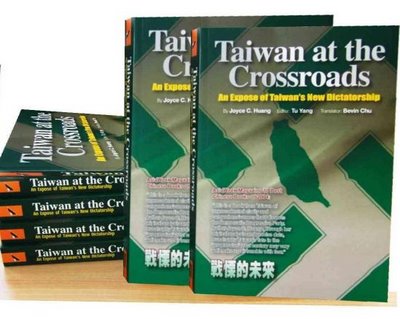
Taiwan at the Crossroads, An Expose of Taiwan's New Dictatorship
Written by Joyce C. Huang, edited by Tu Yang, translated by Bevin Chu, published by BAZACH, 2005, ISBN 986-81084-2-x

CIA World Factbook Map of China
The China Desk offers hard-hitting, no punches pulled commentary on the often stormy Divided China Problem, from an uncompromisingly laissez-faire capitalist, anti-interventionist perspective.
China Desk articles have appeared at the wildly popular libertarian website, LewRockwell.com, where Chu is a columnist/commentator, at the China Post, where Chu is a contributing editor, at Antiwar.com, the best known anti-war website on the Internet, at oOblue, the most popular Pan Blue website on Taiwan, and at Journey to the East, an exquisitely designed website introducing China to the English-speaking West. They have featured prominently at Yahoo! News Full Coverage portals, in Google News Alerts, and have even appeared in Pravda -- the post Cold War, post Communist Pravda, of course.
The China Desk receives tens of thousands of views per month.
China Desk articles on Sino-American relations have been cited by China scholars in American universities, have earned Bevin Chu invitations to speak before the Harvard-Radcliffe Chinese Students Association, and live interviews on talk radio shows in Canada.
Articles explaining the non-threatening reality of post Cold War, post-Communist China to westerners have inspired character attacks against the author by the Falun Gong mouthpiece known as the Epoch Times.
Articles exposing the Dalai Lama's feet of clay and the true nature of the Tibetan independence movement meanwhile, have earned the Politically Incorrect author angry denunciations from the Dalai Lama's official website.
Chu is the son of the late Tsing-kang Chu, a high-ranking diplomat with the Republic of China government on Taiwan. Chu is the translator of the English language edition of "Taiwan at the Crossroads: An Expose of Taiwan's New Dictatorship," a landmark book by the celebrated native Taiwanese liberal reformer and political commentator, Joyce C. Huang (Huang Chi-hsien). "Taiwan at the Crossroads" is an eye-opening expose of the Taiwan independence movement that rips the "democratic" and "progressive" mask from the face of Taiwan independence and reveals it for what it is -- an authoritarian fascist political movement motivated by primitive ethnic hatred.

Taiwan at the Crossroads, An Expose of Taiwan's New Dictatorship
Written by Joyce C. Huang, edited by Tu Yang, translated by Bevin Chu, published by BAZACH, 2005, ISBN 986-81084-2-x
Downloads
PERSONAL FAVORITE WINDOWS FREEWARE SITES

Download.com
http://www.download.com/
FileHippo
http://www.filehippo.com/
Gizmo's Freeware Reviews
http://www.techsupportalert.com/content/top-freeware-picks-category-editors.htm
MajorGeeks
http://www.majorgeeks.com/
SnapFiles
http://www.snapfiles.com/freeware/freeware.html
Softpedia
http://win.softpedia.com/
SourceForge
http://sourceforge.net/
PERSONAL FAVORITE WINDOWS FREEWARE
7-Zip
File archiver with a high compression ratio in 7z format with LZMA and LZMA2 compression. Supported formats: Packing / unpacking: 7z, XZ, BZIP2, GZIP, TAR, ZIP and WIM, Unpacking only: ARJ, CAB, CHM, CPIO, CramFS, DEB, DMG, FAT, HFS, ISO, LZH, LZMA, MBR, MSI, NSIS, NTFS, RAR, RPM, SquashFS, UDF, VHD, WIM, XAR and Z. For ZIP and GZIP formats, 7-Zip provides a compression ratio that is 2-10 % better than the ratio provided by PKZip and WinZip
http://www.7-zip.org/
Belarc Advisor
Builds a detailed profile of your installed software and hardware, missing Microsoft hotfixes, anti-virus status, CIS (Center for Internet Security) benchmarks, and displays the results in your Web browser. All your PC profile information is kept private and is not sent to any web server
http://www.belarc.com/free_download.html
CalcTape
CalcTape is a revolutionary new kind of pocket calculator. With CalcTape, also extensive calculations remain clearly structured. CalcTape makes the arithmetic process visible - you can generate intermediate results and subsequently correct or change all numbers and operations.
https://www.schoettler-software.com/en/calctape/windows
CCleaner (Crap Cleaner)
System optimization and privacy tool removes unused files allowing Windows to run faster, freeing up valuable hard disk space, cleans traces of your online activities such as your Internet history, fast, takes less than a second to run
http://www.ccleaner.com/
Defraggler
Open Shell
VLC Media Player
Multimedia player for various audio and video formats (MPEG-1, MPEG-2, MPEG-4, DivX, mp3, ogg, as well as DVDs, VCDs, and various streaming protocols, can also be used as a server to stream in unicast or multicast in IPv4 or IPv6 on a high-bandwidth network.
http://www.filehippo.com/download_vlc/
Windows Movie Maker 6 for Windows 7/8/8.1
Installs an updated version of Windows Movie Maker 6.0 (WMM6) from Vista, in Windows 7/8/8.1. Windows Movie Maker 6 is the best version of Windows Movie Maker ever offered. It is much better than Windows Live Movie Maker, or WLMM, which comes standard with Windows 7/8/8.1
http://noeld.com/programs.asp?cat=video
http://www.softpedia.com/get/Multimedia/Video/Other-VIDEO-Tools/Windows-Movie-Maker-Installer.shtml

The Linux Penguin
PERSONAL FAVORITE LINUX DISTRO
Linux Mint
Linux Mint is the Linux distro that finally persuaded me to convert to Linux on my desktop PCs, permanently, and not look back. Linux Mint is what has long been promised Windows users -- an Open Source operating system as easy to install as Windows, but which has all the virtues of Linux.
No, I am not double-booting into Linux and Windows. No, I did not partition my hard drive for both Linux and Windows. I formatted my entire hard drive and installed Linux Mint on the entire disk. I will not be going back.
If you're like me, if you're a Windows user who has been waiting for Linux to get its act together so you can finally make the switch, your wait is over. Linux Mint is what you have been waiting for. Linux Mint will give you a seamless, trouble-free installation, and seamless, trouble-free updates thereafter. All through menus and mouse clicks. No line commands required. Linux Mint is what Mandrake, Xandros, and OpenSUSE promised to be, but weren't.
Download the Linux Mint ISO and have Linux up and running within the hour. Complete with apps such as Firefox, Thunderbird, and Open Office. Be the proud owner of an operating system and office suite superior to Windows and Microsoft Office. All for free.
Linux Mint, like almost all Linux distros, is completely free. Your only cost will be a blank thumb drive and a little download time.
I immediately install the latest Linux Mint distro on desktops I build for myself, but Windows applications remain necessary for the notebook PCs I purchase, which come preloaded with Windows operating systems.

Download.com
http://www.download.com/
FileHippo
http://www.filehippo.com/
Gizmo's Freeware Reviews
http://www.techsupportalert.com/content/top-freeware-picks-category-editors.htm
MajorGeeks
http://www.majorgeeks.com/
SnapFiles
http://www.snapfiles.com/freeware/freeware.html
Softpedia
http://win.softpedia.com/
SourceForge
http://sourceforge.net/
PERSONAL FAVORITE WINDOWS FREEWARE
7-Zip
File archiver with a high compression ratio in 7z format with LZMA and LZMA2 compression. Supported formats: Packing / unpacking: 7z, XZ, BZIP2, GZIP, TAR, ZIP and WIM, Unpacking only: ARJ, CAB, CHM, CPIO, CramFS, DEB, DMG, FAT, HFS, ISO, LZH, LZMA, MBR, MSI, NSIS, NTFS, RAR, RPM, SquashFS, UDF, VHD, WIM, XAR and Z. For ZIP and GZIP formats, 7-Zip provides a compression ratio that is 2-10 % better than the ratio provided by PKZip and WinZip
http://www.7-zip.org/
Belarc Advisor
Builds a detailed profile of your installed software and hardware, missing Microsoft hotfixes, anti-virus status, CIS (Center for Internet Security) benchmarks, and displays the results in your Web browser. All your PC profile information is kept private and is not sent to any web server
http://www.belarc.com/free_download.html
CalcTape
CalcTape is a revolutionary new kind of pocket calculator. With CalcTape, also extensive calculations remain clearly structured. CalcTape makes the arithmetic process visible - you can generate intermediate results and subsequently correct or change all numbers and operations.
https://www.schoettler-software.com/en/calctape/windows
CCleaner (Crap Cleaner)
System optimization and privacy tool removes unused files allowing Windows to run faster, freeing up valuable hard disk space, cleans traces of your online activities such as your Internet history, fast, takes less than a second to run
http://www.ccleaner.com/
Defraggler
Speed up your PC with quick & easy defragmentation. Defrag entire hard drives or individual files. Works with HDD and SSD and supports NTFS and FAT32 file systems!
https://www.ccleaner.com/defraggler
Epson Perfection V33 Scanner Driver
http://www.driversepson.com/epson-perfection-v33-driver/
GIMP
An acronym for GNU Image Manipulation Program for photo retouching, image composition and image authoring. Can be used as a simple paint program, an expert quality photo retouching program, an online batch processing system, a mass production image renderer, or image format converter. It is designed to be augmented with plug-ins and extensions to do just about anything
http://www.gimp.org/
http://www.libreoffice.org/download
MiniTool Partition Wizard Free
All-inclusive free partition manager to organize disk partitions to get the best of your hard drive Measure drive performance and analyze disk space usage in simple ways Fully compatible with Windows 10/8.1/8/7 all editions
https://www.partitionwizard.com/free-partition-manager.html
NoteTab Light
Leading-edge text and HTML editor, winner of software industry awards since 1998, easily handles a stack of huge files; lets you format text to your heart's content; does system-wide searches, and multi-line global replacements, even corrects your spelling mistakes, build document templates, add bookmarks, convert text to HTML on-the-fly, and take charge of your code
https://www.notetab.com/notetab-light
https://www.ccleaner.com/defraggler
Epson Perfection V33 Scanner Driver
http://www.driversepson.com/epson-perfection-v33-driver/
FreeCommander
FreeCommander is an easy-to-use alternative to the standard windows file manager
An acronym for GNU Image Manipulation Program for photo retouching, image composition and image authoring. Can be used as a simple paint program, an expert quality photo retouching program, an online batch processing system, a mass production image renderer, or image format converter. It is designed to be augmented with plug-ins and extensions to do just about anything
http://www.gimp.org/
Google Chrome
Browse with the power of Google
With Google apps like Gmail, Google Pay, and Google Assistant, Chrome can help you stay productive and get more out of your browser.
LibreOffice
Power-packed Open Source personal productivity suite for Windows, Macintosh and Linux. Gives you six feature-rich applications for all your document production and data processing needs: Writer, Calc, Impress, Draw, Math and Basehttp://www.libreoffice.org/download
MiniTool Partition Wizard Free
All-inclusive free partition manager to organize disk partitions to get the best of your hard drive Measure drive performance and analyze disk space usage in simple ways Fully compatible with Windows 10/8.1/8/7 all editions
https://www.partitionwizard.com/free-partition-manager.html
NoteTab Light
Leading-edge text and HTML editor, winner of software industry awards since 1998, easily handles a stack of huge files; lets you format text to your heart's content; does system-wide searches, and multi-line global replacements, even corrects your spelling mistakes, build document templates, add bookmarks, convert text to HTML on-the-fly, and take charge of your code
https://www.notetab.com/notetab-light
Open Shell
Classic style Start Menu for Windows 7, 8, 8.1, 10. Reborn of Classic Shell
Open Shell is the continuation of Classic Shell, which was is a collection of features that were available in older versions of Windows but were later removed.
Features: Classic style Start Menu for Windows 7, 8, 8.1, 10 Toolbar for Windows Explorer Classic copy UI (Windows 7 only) Show file size in Explorer status bar Title bar and status bar for Internet Explorer
https://open-shell.github.io/Open-Shell-Menu/
PosterPrint
Did you ever need to print out a large poster or banner but you couldn't make it big enough on your standard printer? PosterPrint can take a document created by any Windows ® printing application, zoom and print it on several standard sheets of paper using any available printer. This is a Multipage Printing - if a poster doesn't fit into one sheet of paper, print it on several and glue (or tape) them together! PosterPrint automatically adds glue margins, prints trim and alignment guides and offers several ways for easy zooming
http://www.grandutils.com/PosterPrint/
qBittorrent
The qBittorrent project aims to provide an open-source software alternative to µTorrent. Additionally, qBittorrent runs and provides the same features on all major platforms (FreeBSD, Linux, macOS, OS/2, Windows).
https://www.qbittorrent.org/
https://www.qbittorrent.org/
VLC Media Player
Multimedia player for various audio and video formats (MPEG-1, MPEG-2, MPEG-4, DivX, mp3, ogg, as well as DVDs, VCDs, and various streaming protocols, can also be used as a server to stream in unicast or multicast in IPv4 or IPv6 on a high-bandwidth network.
http://www.filehippo.com/download_vlc/
Windows Movie Maker 6 for Windows 7/8/8.1
Installs an updated version of Windows Movie Maker 6.0 (WMM6) from Vista, in Windows 7/8/8.1. Windows Movie Maker 6 is the best version of Windows Movie Maker ever offered. It is much better than Windows Live Movie Maker, or WLMM, which comes standard with Windows 7/8/8.1
http://noeld.com/programs.asp?cat=video
http://www.softpedia.com/get/Multimedia/Video/Other-VIDEO-Tools/Windows-Movie-Maker-Installer.shtml

The Linux Penguin
PERSONAL FAVORITE LINUX DISTRO
Linux Mint
Linux Mint is the Linux distro that finally persuaded me to convert to Linux on my desktop PCs, permanently, and not look back. Linux Mint is what has long been promised Windows users -- an Open Source operating system as easy to install as Windows, but which has all the virtues of Linux.
No, I am not double-booting into Linux and Windows. No, I did not partition my hard drive for both Linux and Windows. I formatted my entire hard drive and installed Linux Mint on the entire disk. I will not be going back.
If you're like me, if you're a Windows user who has been waiting for Linux to get its act together so you can finally make the switch, your wait is over. Linux Mint is what you have been waiting for. Linux Mint will give you a seamless, trouble-free installation, and seamless, trouble-free updates thereafter. All through menus and mouse clicks. No line commands required. Linux Mint is what Mandrake, Xandros, and OpenSUSE promised to be, but weren't.
Download the Linux Mint ISO and have Linux up and running within the hour. Complete with apps such as Firefox, Thunderbird, and Open Office. Be the proud owner of an operating system and office suite superior to Windows and Microsoft Office. All for free.
Linux Mint, like almost all Linux distros, is completely free. Your only cost will be a blank thumb drive and a little download time.
Which China Desk?
1. The China Desk at Blogspot [http://thechinadesk.blogspot.com]
is the new home of The China Desk.
2. The China Desk at WordPress [http://thechinadesk.wordpress.com]
is a mirror for China Desk articles.
3. The China Desk at Tripod [http://thechinadesk.tripod.com]
is being phased out.
is the new home of The China Desk.
2. The China Desk at WordPress [http://thechinadesk.wordpress.com]
is a mirror for China Desk articles.
3. The China Desk at Tripod [http://thechinadesk.tripod.com]
is being phased out.
Links
CHINA AND THE CHINESE

Cyrus Janssen
Cyrus Janssen is an American Expat that has lived in Shanghai, Hong Kong, and Vancouver over the past 13 years. He is passionate about showing a true insight into China and loves sharing about his travels around the world
Global Times
China's most informative English-language newspaper the Global Times distances itself from the extreme provocation common in the Western media’s China reportage, taking great pains to present facts and views that help readers better understand China
Gregory Clark
Former Australian diplomat, vice president of Akita International University, and a bona fide expert on East Asian affairs
Iris Chang - the official home page of Iris Chang
bestselling author of The Rape of Nanking, The Chinese in America, and Thread of the Silkworm
http://www.irischang.net/
Journey to the East
A diverse group of Chinese-Americans presenting their heritage, good, bad, beautiful, ugly
Martin Jacques
Martin Jacques is the author of the global best-seller When China Rules the World: the End of the Western World and the Birth of a New Global Order, which has since sold over 350,000 copies and been translated into fifteen languages. Martin is a Visiting Professor at Tsinghua University, Beijing, and Fudan University, Shanghai
Nathan Rich
"It's okay to love China"
New Party - 新黨 [traditional Chinese]
I know of no political party that is 100% corruption free, except the New Party
One China - 中國統一聯盟 [traditional Chinese]
One China (Alliance for the Reunification of China) promotes national unity, domestic peace, and a democratic nation
Qiao Collective
Qiao Collective is a diaspora Chinese media collective challenging U.S. aggression on China, our name (桥) plays on the Chinese words 桥 qiáo (meaning bridge and pronounced “chee-ow”) and 华侨 huáqiáo (meaning overseas Chinese)
Robert Temple
Robert Temple is visiting professor of the history and philosophy of science at Tsinghua University in Beijing; fellow of the Royal Astronomical Society; member of the Egypt Exploration Society, Royal Historical Society, Institute of Classical Studies, and the Society for the Promotion of Hellenic Studies; and visiting research fellow of the University of the Aegean in Greece. He is the author of 12 books, including The Genius of China.
Tom Fowdy
Tom Fowdy graduated from Oxford University’s China Studies Program. He has lived in Hong Kong, Shanghai, Beijing, Seoul and Australia. Fowdy endeavors to keep an open and objective view of the world, even if that means challenging conventional understandings of things or questioning things people do not want to question.
The Unz Review


Alternative media outlets of the Left and Right have become a crucial supplement to our knowledge of the world, providing those perspectives usually ignored by our mainstream media. This small webzine will aim to provide convenient access to at least a fraction of those voices and topics.
https://www.unz.com/tcategory/foreign-policy/
CLASSICAL LIBERALISM / LIBERTARIANISM / FREE MARKET ANARCHISM
Advocates for Self-Government
Home of the World's Smallest Political Quiz, the original Internet political quiz
http://www.theadvocates.org/
Antiwar.com
The pre-eminent non-interventionist site on the internet, daily coverage of breaking news, and analysis
http://www.antiwar.com/
Eric Peters Autos
Automobiles, Motorcycles, and Libertarian Politics
Future of Freedom Foundation
Providing the moral and economic case for individual liberty, free markets, private property, and limited government
Guncite
Until the Second Amendment is treated as normal constitutional law, this web site will always be under construction
LewRockwell.com
Property, Freedom, Peace
Ludwig von Mises Institute
Defending the market economy, private property, sound money, and peaceful international relations
http://www.mises.org/
Molinari Institute
To promote the philosophy of Market Anarchism as a sane, consensual alternative to the hypertrophic violence of the State
Ron Paul Institute for Peace and Prosperity
The Institute continues and expands Dr. Paul’s lifetime of public advocacy for a peaceful foreign policy and the protection of civil liberties at home. A prosperous America is profoundly linked to a foreign policy rooted in peaceful relations and trade with all. With peace, comes real prosperity.
GREATER CHINA AND EAST ASIAN NEWS
United Daily News - 聯合報 [traditional Chinese]
Largest circulation Chinese language daily on Taiwan, the only one still defying the Taiwan independence Green Terror
http://www.udn.com.tw/NEWS/
MILITARY AFFAIRS
G2mil, The Magazine of Future Warfare
What someone doesn’t want you to publish is journalism, all else is publicity
PHILOSOPHY / PSYCHOLOGY
Brugh Joy
One of the wisest men I have ever known, whose profound teachings forever transformed my perception of reality


Subscribe to:
Posts (Atom)